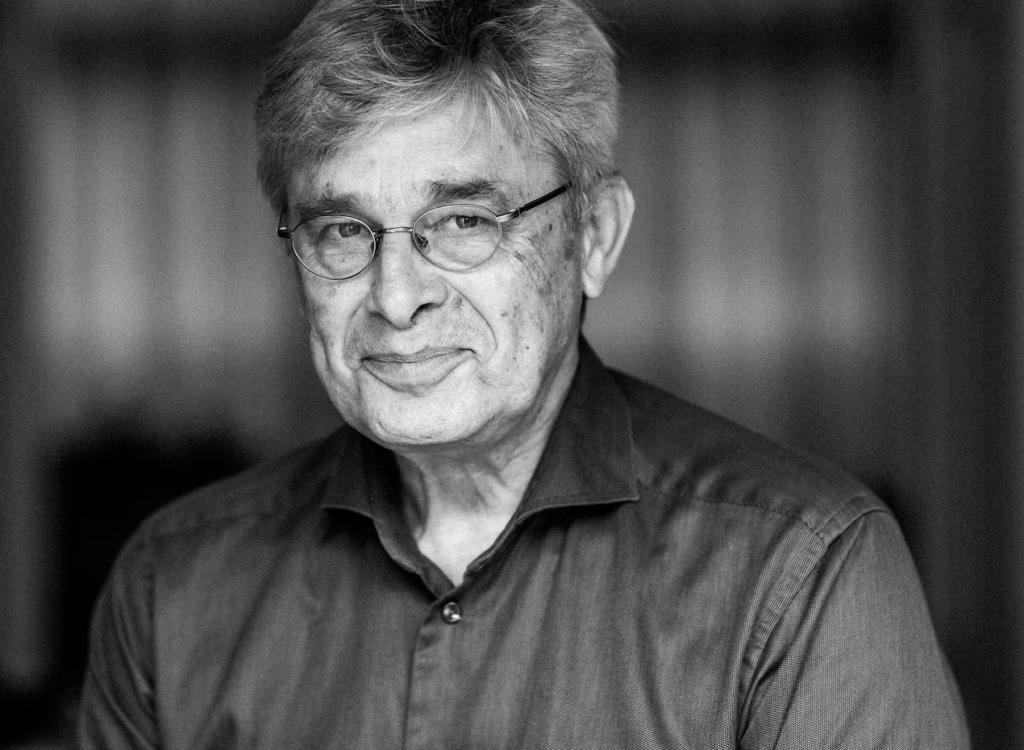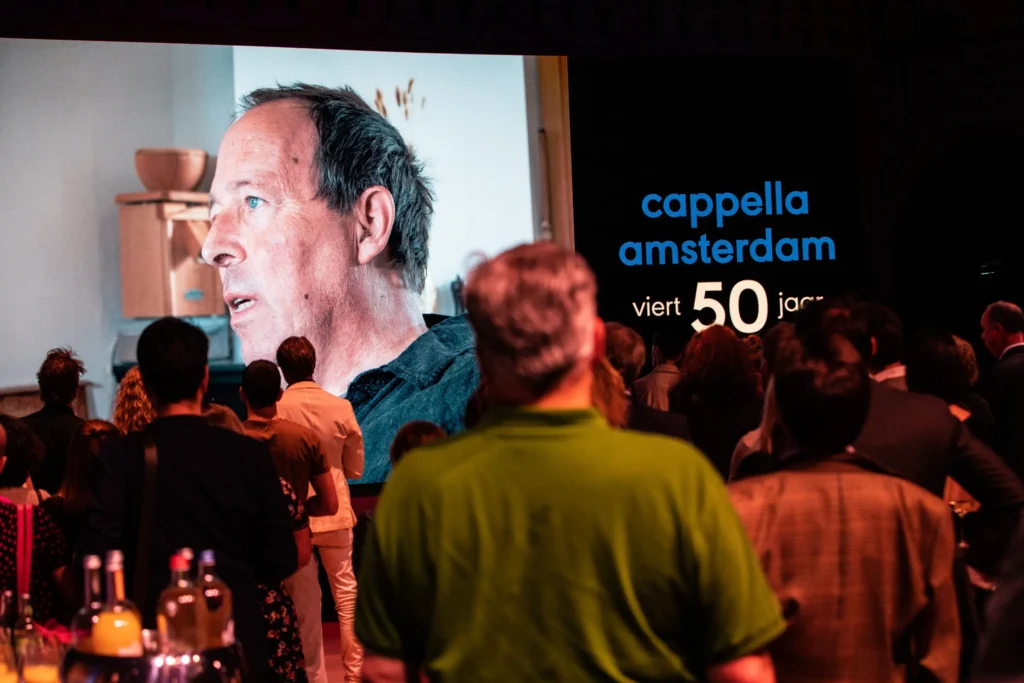
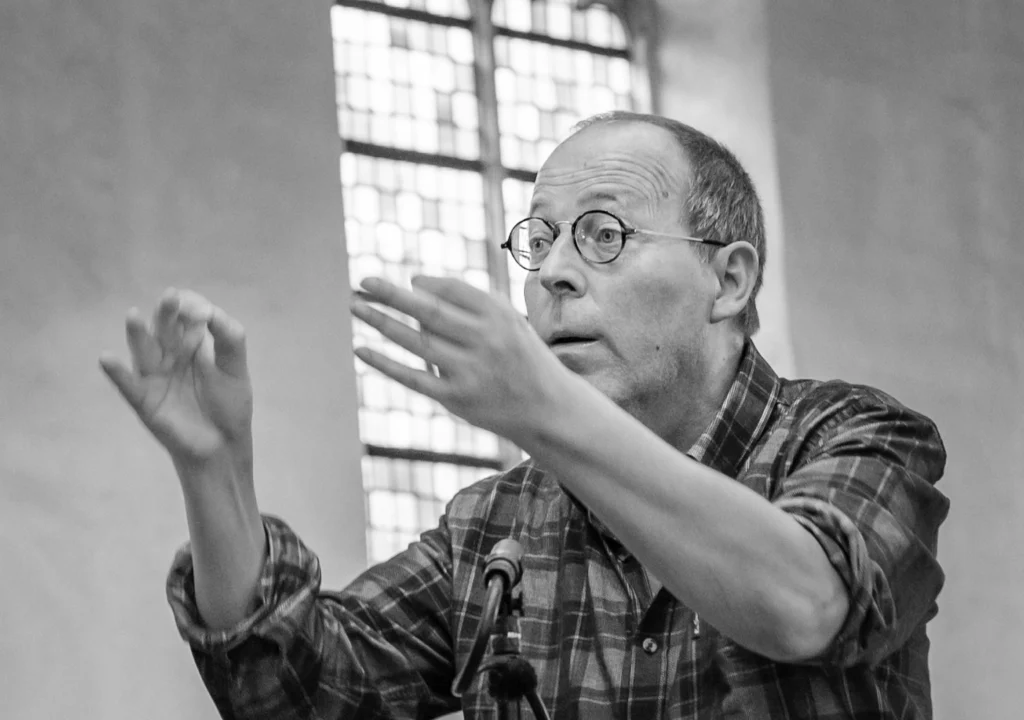
He conducts a repertoire ranging from the 12th century to the present day, has led choirs in Amsterdam, Berlin, Tallinn, and Lausanne (and soon in Zagreb), and has been at the helm of Cappella Amsterdam for more than thirty years. A portrait of a conductor who sees music as a direct connection between the voice and the soul.
background
Daniel Reuss was born in Leiden on July 2, 1961. His journey into choral music began at the age of sixteen, when he first sang under the direction of conductor Bruno de Greeve with the Audite Nova choir in Nijmegen. That experience is a revelation. “I want that, too,” he thinks. What follows is a conflict with his parents, who at first don’t understand his decision to attend the conservatory. But he knows he wants to become a choir conductor, so Reuss keeps at it. He is studying choral conducting at the Rotterdam Conservatory under Barend Schuurman, one of the leading Dutch choral educators of his generation.
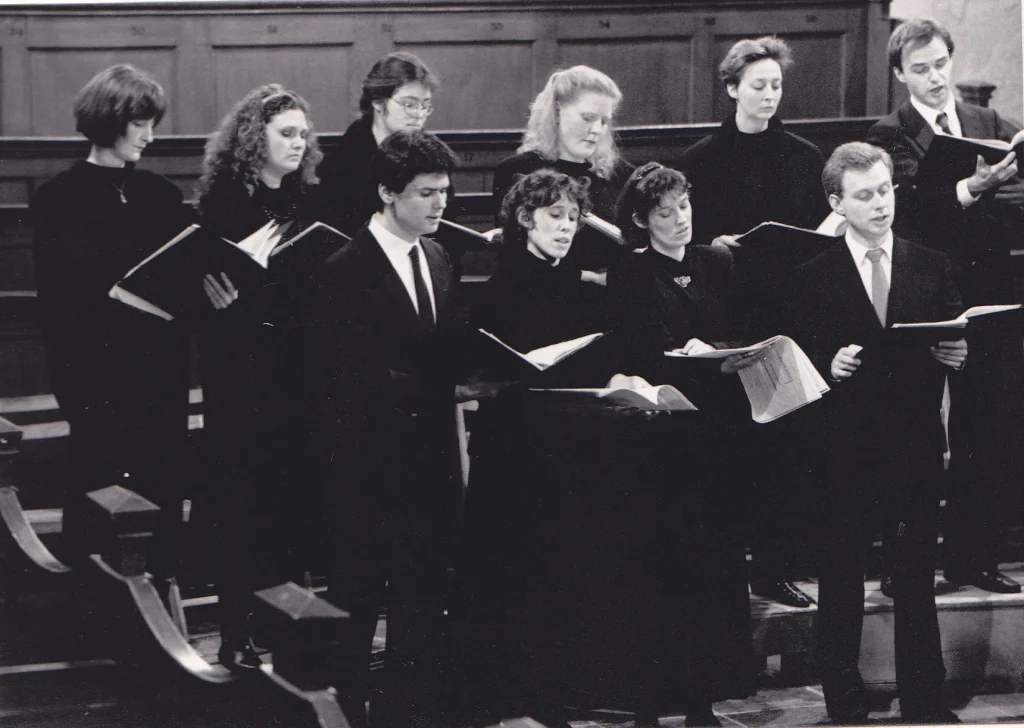
But first, he sings. He considers that foundation—learning to make music, listen, and collaborate as a singer—to be indispensable. “If you jump right into management, you’ll miss that context,” he says. At the age of 21, in 1982, he founded the Arnhem Early Music Choir. In those early years, he also conducted the vocal ensemble VENUS and, later, the Dutch Student Chamber Choir. At the same time, he travels back and forth to Amsterdam to rehearse as a singer with Cappella Amsterdam. These early works are characteristic of his style: expansive, engaging, and always focused on the singers in front of him.
Daniel Reuss Takes the Lead from Within
In 1990, Reuss took over as artistic director of Cappella Amsterdam from its founder, Jan Boeke. The transfer takes place without a formal selection process. Reuss knows the choir inside and out: he sang in it for years as a bass, not with any ambition to ever conduct it, but simply because he thought it was a wonderful choir.
This means he doesn’t arrive as an outsider, but as someone who is already immersed in the ensemble’s culture. What he has learned as a singer—namely, the repertoire and making music with and for one another—he brings with him as a conductor. Boeke’s approach was somewhat more ethereal; Reuss, in his own words, “sings in a somewhat more physical way.” A subtle but significant shift.
What follows is a period of steady professionalization. Cappella Amsterdam is evolving from a project ensemble into a professional chamber choir. The repertoire is expanding considerably: in addition to early polyphony and Baroque music, Romantic and contemporary works are now regularly included in the program. In doing so, Reuss established the artistic identity with which the choir is still associated today: an unusually broad historical and stylistic range, underpinned by a single, recognizable sound. With that sound, the choir keeps the chamber choir tradition alive while simultaneously renewing it, thus bridging stylistic periods to genuinely move people with the human voice.
“Singing is the most direct way of making music. With this human instrument, you create a direct connection between ‘the soul’—let’s call it that—and what happens musically. Making it sound that way—that’s what I consider the most beautiful aspect of my craft.”
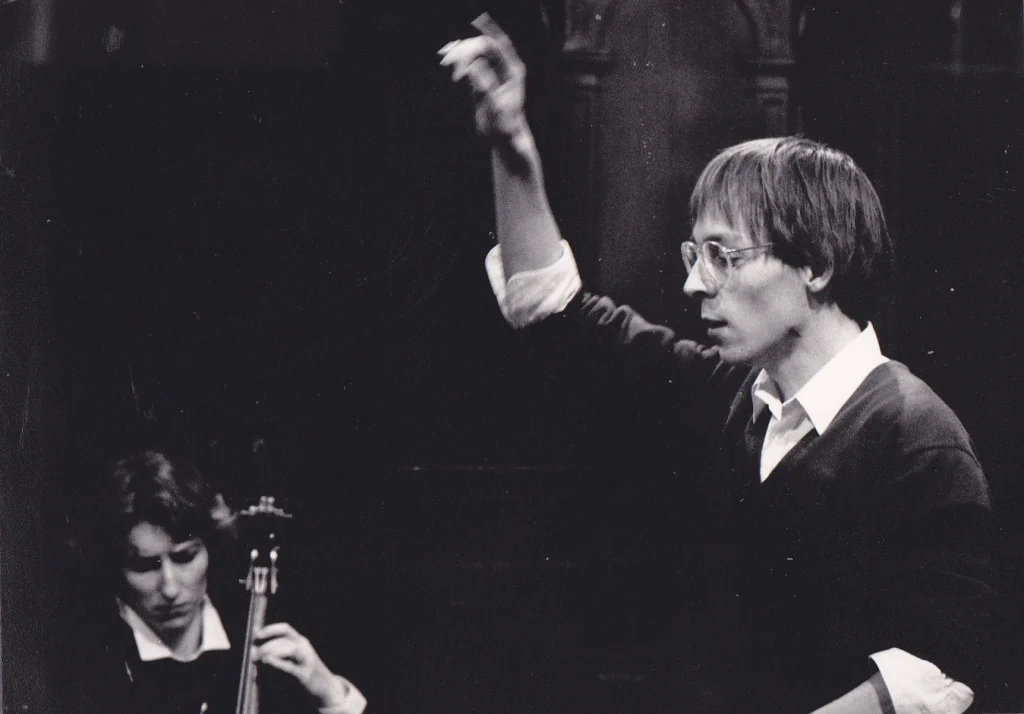
Foto uit oude doos: Daniel dirigeert in 1987 in de Waalse Kerk, door Margriet Agricola
The Convinced Non-Specialist
Reuss describes himself as a “committed non-specialist.” That self-description says a lot about his artistic stance. He refuses to choose a clearly defined specialization (early music or contemporary, symphonic or vocal), conducts repertoire spanning the 12th through the 21st centuries, and feels at home in musical worlds that may seem contradictory to some.
That breadth is not eclecticism but a philosophy. Reuss views music history as an ongoing conversation: between composers, between periods, and between performers and listeners. That conversation calls for a conductor who can adapt without losing his artistic core. In fact, that is exactly what critics and singers consistently recognize in him: a refined ear for balance, intonation, and timbre, regardless of the repertoire on the music stands.
Berlin, Tallinn, Lausanne
In addition to his work with Cappella Amsterdam, Reuss served as chief conductor of the RIAS Kammerchor in Berlin—one of the world’s most renowned chamber choirs—from 2003 to 2006. In the summer of 2006, he was personally invited by Pierre Boulez to serve as a teacher and conductor at the Lucerne Festival Academy. That invitation speaks volumes: Reuss is not only a master of the vocal repertoire, but a musician whose vision extends far enough to be taken seriously in any context.
From 2008 to 2013, he combined his position in Amsterdam with that of chief conductor of the Estonian Philharmonic Chamber Choir in Tallinn. That dual appointment led to a joint CD production by Frank Martins in 2010 Golgotha, which received a Grammy nomination for Best Choral Performance that same year. From 2015 to 2020, he also served as chief conductor of the Ensemble Vocal Lausanne in Switzerland.
The Existential Crisis
In 2016, Cappella Amsterdam received a rejection from the Performing Arts Fund. For Reuss, the shock is immense: “Cappella is my life’s work.” After all, he has contributed immensely to the professionalization of the field and to increasing its international recognition. He sees that all of that is in danger of vanishing in an instant.
“Surprised and bewildered,” he says, describing his reaction. But he remains a fighter. What followed was a period of survival made possible by broad support: private funding, strong business leadership, and the tremendous loyalty of the singers themselves. Another crucial factor is the collaboration with the Orchestra of the Eighteenth Century, which helps the choir stay afloat financially through a series of joint concerts.
On November 2 of that same year, 2016, Reuss received the Order of the Dutch Lion, presented by the chair of the Presidium of the Amsterdam City Council. The government recognizes his exceptional contributions to Dutch musical culture.
In the end, Cappella Amsterdam is once again able to count on support.
A living organism
For Reuss, Cappella Amsterdam is not an institution but a living organism: something that grows, breathes, and has developed its own character. That character didn’t just develop on its own. Reuss actively worked to build it: by seeking out singers who are not only technically skilled but also a good fit for the ensemble’s aesthetic and culture. People who dare to contribute their ideas, who give something back. The result is a choir with an unmistakable sound of its own and a recognizable artistic personality, even when the choir performs under the direction of a different conductor.
A discography full of awards
2004 Works by Martin & Messiaen (RIAS Kammerchor) | Diapason d’Or of the Year · Prize d. German Record Critics’ Association
2009 Lux Aeterna — Ligeti / Heppener (Cappella Amsterdam) | Diapason d’Or of the Year
2010 Golgotha — Frank Martin (Cappella Amsterdam & EPCC) | Grammy nomination
2013 Janáček Choral Works (Cappella Amsterdam) | Edison Klassiek · Diapason d’Or · Choc de Classica
2017 Kanon Pokajanen — Arvo Pärt (Cappella Amsterdam) | Edison Klassiek
2018 A German Requiem — Brahms (Cappella Amsterdam & Orchestra of the Eighteenth Century) | VSCD Classical Music Award
2024 Missa Sancti Georgii — Herman Finkers (Cappella Amsterdam & Holland Baroque) | Edison Classical Audience Award
2026 Stravinsky Late Works (Cappella Amsterdam & Noord Nederlands Orkest) | ★★★★★ The Guardian (UK) · ★★★★★ Leeuwarder Courant · Gramophone (UK) Editor’s Choice for February · BBC Music Magazine (UK) Choral Choice of the Month · Choc de Classica Award · German Record Critics’ Award · Diapason d’Or · Preis der Deutschen Schallplattenkritik
The Person Behind the Conductor
Anyone who hears Reuss talk about his field will notice that he is less fascinated by grand abstractions than by concrete matters. He prefers to mention a specific chord, a specific breath taken by a singer, or a specific moment in a performance. And he says quite bluntly that he enjoys chatting with the butcher and the greengrocer, because those conversations bring him closer to life than a theoretical discussion about historical performance practice. That grounding in everyday life isn’t a pose, but a way to keep music from drifting away from the people for whom it is meant.
In addition to his performing career, Reuss is affiliated with the Conservatory of Amsterdam as a professor of choral conducting, where he mentors the next generation of conductors. The transfer of knowledge—from teacher to student, and from choir to audience—seems just as natural to him as conducting itself.