Calefax began as a school orchestra at a high school in Amsterdam and went on to become a world-renowned ensemble and the pioneers of the reed quintet.
From a bold question to the founding
It was November 1985. At the Barlaeus Gymnasium in Amsterdam, a school orchestra was rehearsing for an opera by composer Willem van Manen. Four wind players from that orchestra had a bold request: they asked the composer if he would write a piece especially for them. To their surprise, he said yes, and even offered to play the clarinet himself. That’s how Calefax began.
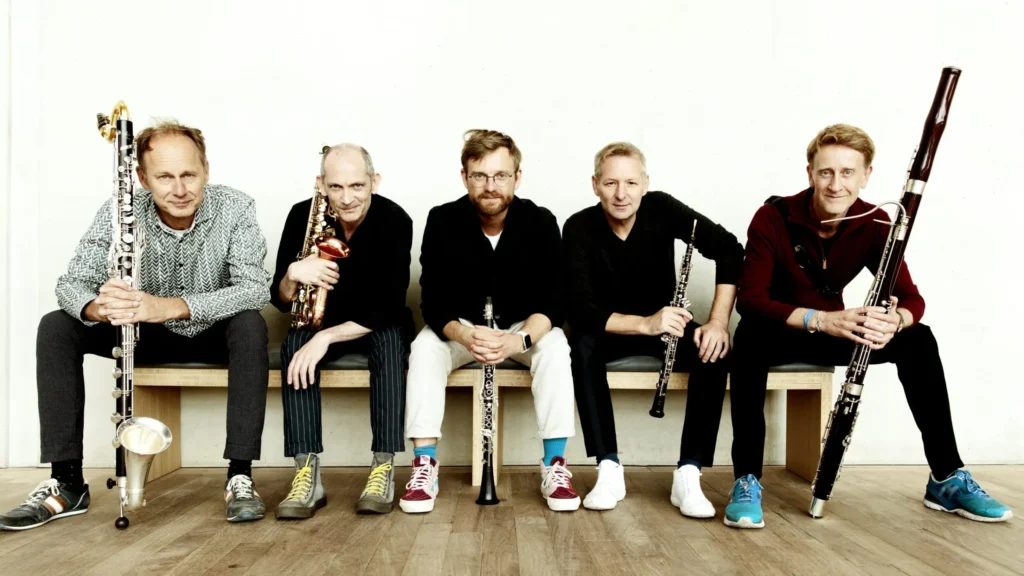
What those students didn’t know was that they were in the process of creating an entirely new genre of music. The reed quintet: a combination of oboe, clarinet, saxophone, bass clarinet, and bassoon. That simply didn’t exist yet. There was no repertoire, no tradition, and no audience. Just five reed players and the curiosity to discover what they could do together.
“Five exceptionally talented Dutch gentlemen who almost made the reed quintet seem like the best musical format on the planet.”
— The Times“They’ve created an entirely new genre! As if that weren’t enough, they serve as mentors to young groups like us—they open doors for us.”
— María Losada Burgo, Dianto Reed Quintet
Why does it sound so special?
The secret to the Calefax sound lies in the relationship between the five instruments. The oboe, clarinet, saxophone, bass clarinet, and bassoon all share the same principle: a reed that vibrates. That shared tonal foundation creates a blend that is more difficult to achieve with other ensembles. Calefax is praised for their“oneness”: how the five voices come together as a single organism.
At the same time, each instrument also has its own unique character. The oboe is sharp and plaintive, the bassoon deep and warm, and the saxophone jazzy and smooth. The ensemble’s strength lies in that tension between unity and diversity: it is both cohesive and incredibly multifaceted.
~1,000 arrangements spanning eight centuries of music history
23 CDs released, to rave reviews from the press
Over 80 reed quintets are following in their footsteps worldwide
Pioneers Without a Repertoire
Anyone who invents a new genre must also invent the corresponding repertoire. Calefax began by arranging music—rewriting existing pieces for the new instrumentation. What began as an experiment grew into a library of nearly a thousand works, ranging from medieval polyphony arranged for reed quintet to contemporary compositions.
Saxophonist Raaf Hekkema arranged an estimated half of that repertoire himself. One of his most talked-about projects was an arrangement of all 24 of Paganini’s violin caprices for solo saxophone, for which he won the 2007 ECHO Klassik Award for Instrumentalist of the Year won.
In addition to arranging music, Calefax also commissions new pieces every year and organizes a composition contest that attracts dozens of entries. The best arrangements are published under the name Calefax Edition, so that the more than eighty reed quintets worldwide—from Argentina to New Zealand—can also perform them. Of those, 11 were performed at the “Calefax Riet Festival” anniversary festival in 2025.
“They’ve created an entirely new genre! As if that weren’t enough, they serve as mentors to young groups like us—they open doors for us.”
— María Losada Burgo, Dianto Reed Quintet (NRC)“Calefax are true pioneers; they paved the way for all of us. And now the path is branching out.”
– Yaroslav Sadovyy, Kalamos Reed Quintet (NRC)
From Bach to Nina Simone
Calefax draws no lines between genres or eras. In a single concert, they can easily play Bach, Duke Ellington, Debussy, and Nina Simone. That breadth isn’t a gimmick—it’s a conviction. All music is treated equally, regardless of its origin or era.
NRC wrote about their album An American Rhapsody that Calefax’s arrangements are “not a faithful translation or reproduction of the original,” but add something: “… they let you taste and discover new flavors in familiar music.” That is exactly the promise that Calefax has been keeping for forty years.
What now?
After forty years, Calefax has grown from a pioneering ensemble into an institution. Still, every concert feels like a journey of discovery. The curiosity that drove five high school students in 1985 has never faded.
In September 2025, the ensemble announced that bass clarinetist Jelte Althuis was leaving after 32 years with the group. A new chapter is beginning. Anyone who knows Calefax even a little bit knows that they’ll write that chapter in their own, inimitable way.
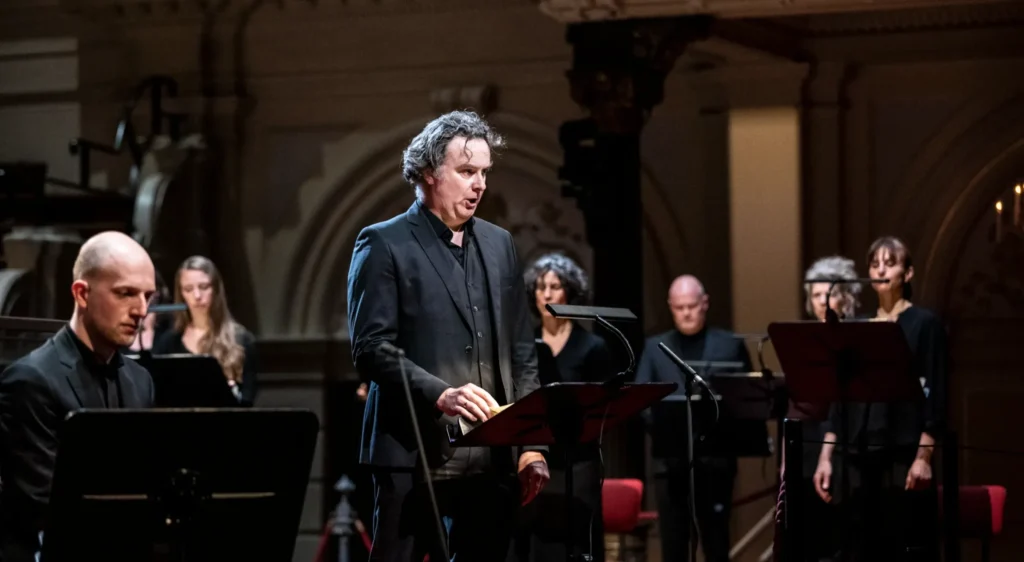
In June 2026, Calefax will join forces with Cappella Amsterdam, Female Economy, and Troupe Courage De Stoet: a 2.5-hour music-theater experience through Amsterdam (Nieuw-)West, featuring a four-meter-tall puppet, live music by Calefax and Cappella Amsterdam, and stories about grief, farewells, and the will to live.
Click here for tickets and more information here.