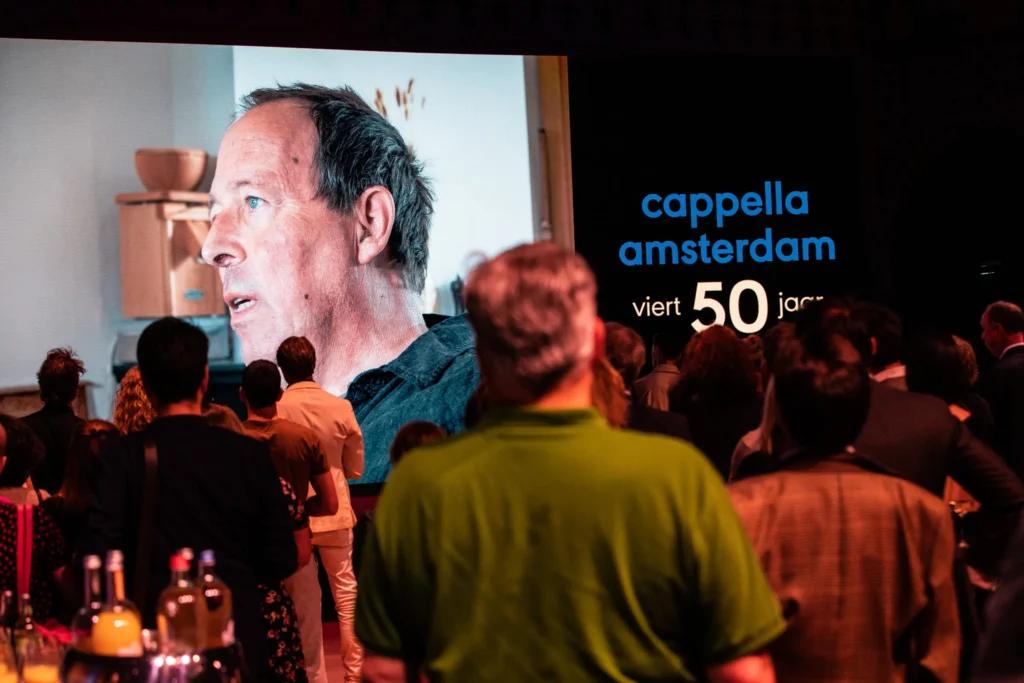
On 12 November 2026, De opstijging (The Ascent), a new choral work by Elmer Schönberger, will be heard for the first time at the Muziekgebouw aan ’t IJ in Amsterdam. It is part of Polderklanken (Sounds from the Polder), the programme in which Cappella Amsterdam and chief conductor Daniel Reuss place five Dutch composers side by side: Rudolf Escher, Ton de Leeuw, Elmer Schönberger, Mathilde Wantenaar and Georgi Sztojanov. More than eighty years separate the birth of the oldest (1912) from that of the youngest (1993). That makes the programme a cross-section of Dutch choral music from the mid-twentieth century to the present day, and a good occasion to look at how that landscape fits together.
Where the Dutch choral tradition begins
Anyone tracing the history of Dutch choral music is led back to Jan Pieterszoon Sweelinck (1562-1621), organist of the Oude Kerk in Amsterdam. He set all 150 psalms to music, in French, using the rhymed texts of the Genevan Psalter. Cappella Amsterdam was founded in 1970 precisely to sing this vocal polyphony. In the early twentieth century, composers such as Alphons Diepenbrock and Willem Pijper set out to find a distinctly Dutch musical language. Pijper became especially important as a teacher: one of his composition students was Rudolf Escher, the oldest composer in Polderklanken.
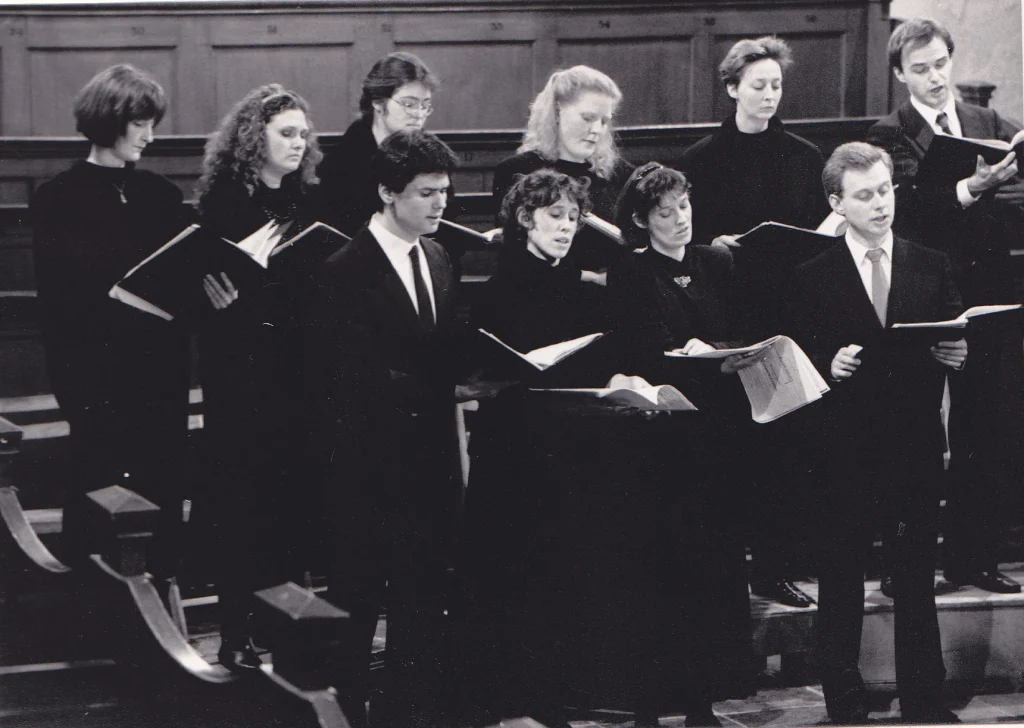
Cappella Amsterdam in 1987 in de Waalse Kerk
Rudolf Escher and French poetry
Rudolf Escher (1912-1980) wrote music that brings together the influence of French Impressionism and that of the Second Viennese School (Schoenberg, Berg and Webern). Much of his early work was lost when his house burned down during the bombing of Rotterdam in May 1940. In Ciel, air et vents, Escher sets a sonnet by the sixteenth-century French poet Pierre de Ronsard. In it, the poet calls on the sky, the air, the winds, the mountains and the forests to carry his farewell to his beloved. Escher gives this sequence of landscape elements a layered choral setting, in which the voices continually follow and overlap one another.
Ton de Leeuw: Eastern influences in Western choral music
Ton de Leeuw (1926-1996) studied with Olivier Messiaen in Paris and with the ethnomusicologist Jaap Kunst, a specialist in Indonesian music. Travels to India, Japan and Indonesia had a major influence on his work. From 1959 to 1986 he taught composition at the Conservatorium van Amsterdam, where he trained an entire generation of Dutch composers. His book Muziek van de twintigste eeuw (1964), published in English as Music of the Twentieth Century, is still regarded as a standard work.
In his late choral works, De Leeuw worked with what he called ‘extended modality’: harmonies built on scales outside the familiar major and minor, so that the music does not constantly drive towards a resolution but can rest on a single field of sound. À cette heure du jour (1992) is an example. The work tells of a Sumerian man who wishes to seal his love for a goddess with an ecstatic sacrifice.
Elmer Schönberger: a composer with a writer’s ear
In the Netherlands, Elmer Schönberger (*1950) is at least as well known as a writer. He studied musicology, piano and composition, wrote about music for many years in Vrij Nederland and de Volkskrant, and published essay collections such as De wellustige tandarts & andere componisten (The Lustful Dentist & Other Composers, 1985). Together with Louis Andriessen, the Dutch composer with the greatest international influence of the past half-century, he wrote Het apollinisch uurwerk (The Apollonian Clockwork), a book about Stravinsky. For a long time writing took precedence over composing; in recent years Schönberger has been composing more than before. His keen ear for text and context follows from that background. De opstijging will be heard for the first time in Polderklanken.
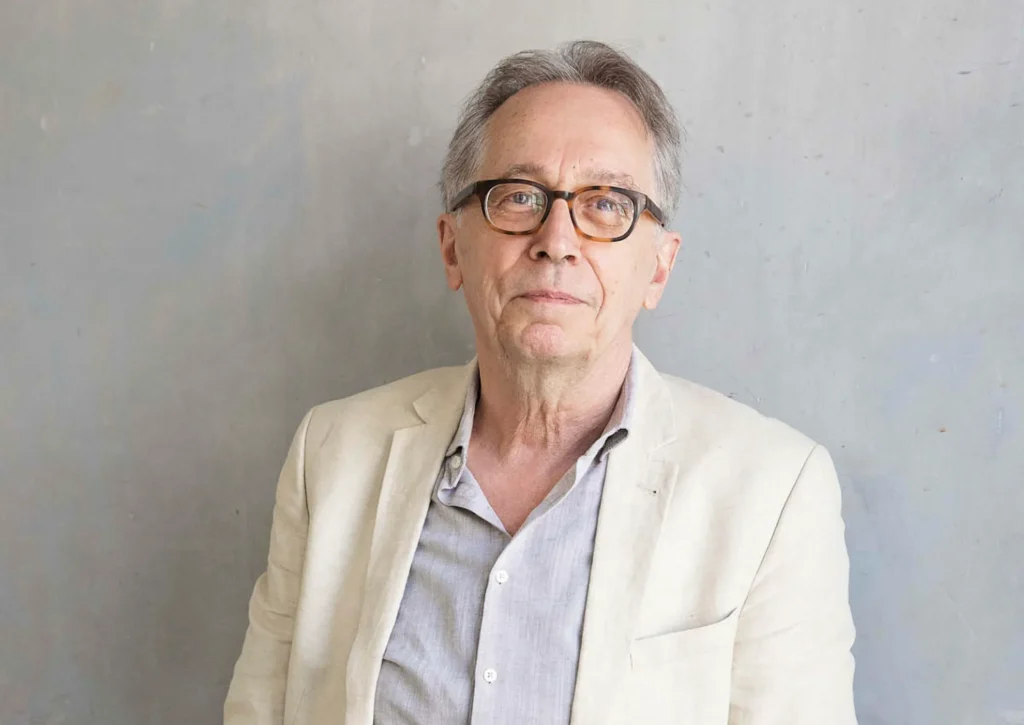
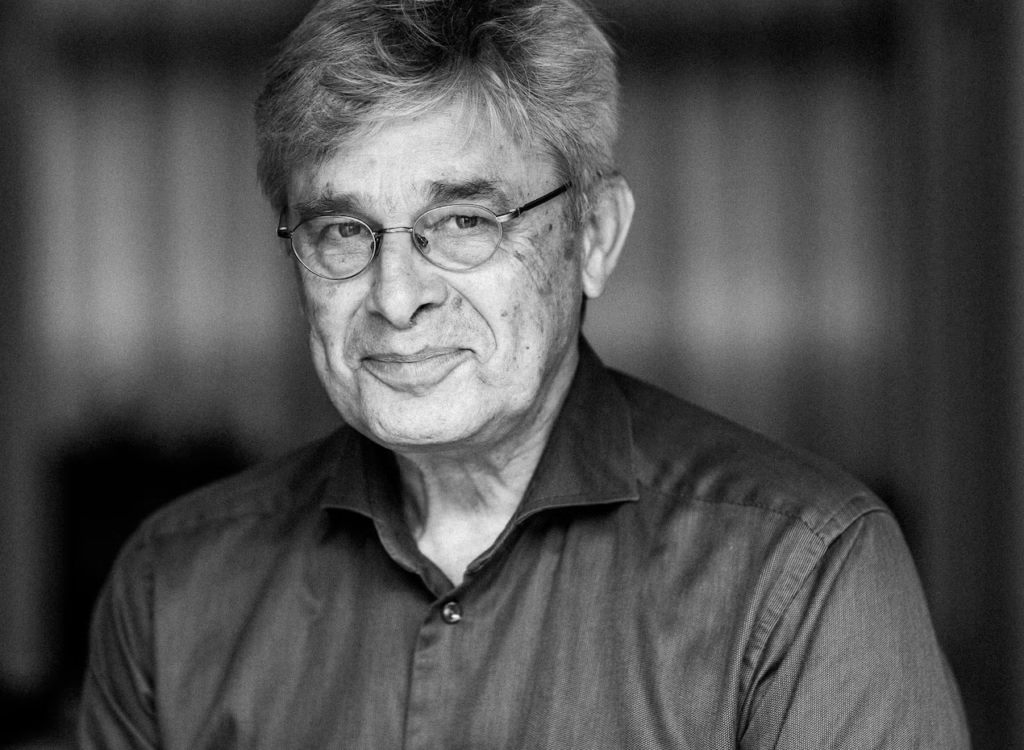
Portretfoto Elmer Schönberger. Fotograaf Ilja Keizer
Mathilde Wantenaar: Juan de la Cruz for choir and cello
Mathilde Wantenaar (*1993) represents the youngest generation of Dutch composers. Her La Noche Oscura del Alma was premiered at the tenth Amsterdam Cello Biennale, performed by Cappella Amsterdam under the direction of Daniel Reuss, with cellists Johannes Moser, Pieter Wispelwey and Kristina Blaumane. Wantenaar drew inspiration from Sonnengesang by the Russian composer Sofia Gubaidulina, a work set to a text by Francis of Assisi. She herself chose a poem by the sixteenth-century Spanish mystic Juan de la Cruz (Saint John of the Cross). In it, the soul leaves the house unseen at night to meet the beloved; the darkness, threatening at first, becomes the guide as the poem unfolds. In Polderklanken the work is performed again, with cellist Lidy Blijdorp.
Read more about this work in our earlier article on La Noche Oscura del Alma.
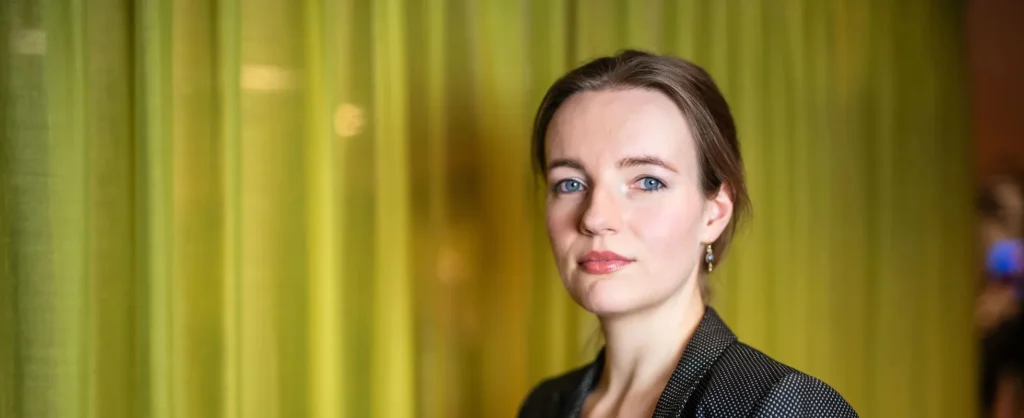
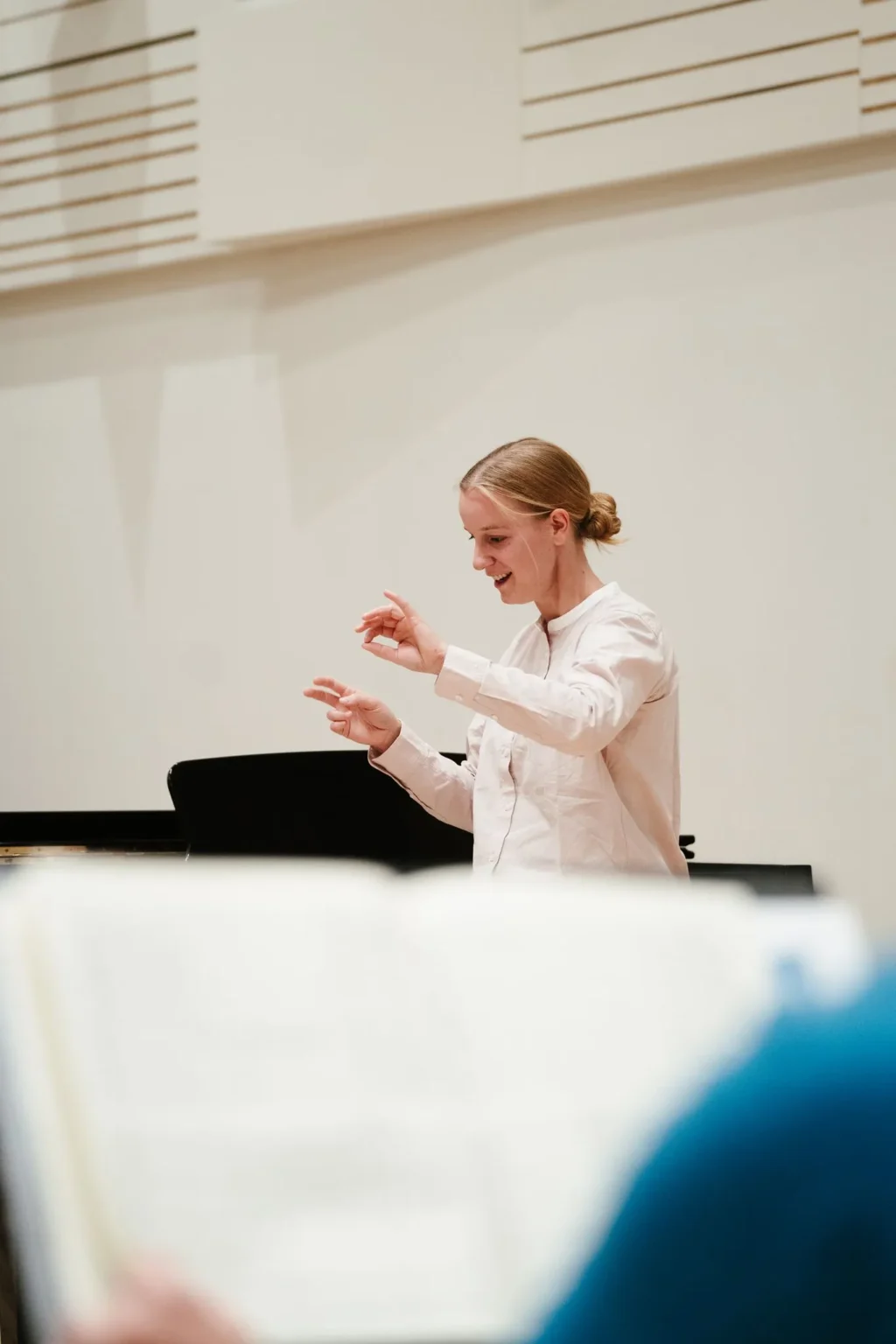
Mathilde Wantenaar
Georgi Sztojanov: In Lumine Tuo
Georgi Sztojanov (*1985) was born in Dobrich, Bulgaria, grew up in Hungary, and lives and works in the Netherlands. He holds master’s degrees in composition from the Liszt Academy in Budapest and the Royal Conservatoire in The Hague. Sztojanov is also a tenor: he sings in the Netherlands Radio Choir (Groot Omroepkoor), where he also works as a vocal coach. That hands-on experience with choral voices can be heard in the way he writes for choir.
He wrote In lumine tuo in memory of Geert Berghs (1953-2025). Until 2023, Berghs was a voice teacher in the choral conducting programme of the Conservatorium van Amsterdam. Trained as a physician, he sang in Ton Koopman’s Amsterdam Baroque Choir, among others, and carried out research at KU Leuven into the ageing singing voice. The title is taken from Psalm 36: ‘in lumine tuo videbimus lumen’: in thy light shall we see light.
what connects these five composers
Stylistically, the five composers of Polderklanken are far apart. What connects them is a line of teachers and students. Willem Pijper trained Rudolf Escher as a composer. Robert Heppener gave Elmer Schönberger private composition lessons. From 1959 to 1986, Ton de Leeuw taught an entire generation of composers at the Conservatorium van Amsterdam. At the same conservatory, voice teacher Geert Berghs trained choral conductors until 2023. He also founded Meesters&Gezellen (Masters & Journeymen), a development programme in which young singers form a choir together with experienced professionals. That choir sang Georgi Sztojanov’s work on several occasions, including in editions conducted by Daniel Reuss. In lumine tuo, Sztojanov’s memorial for Berghs, is also on the programme of the 2027 edition.
This is how the Dutch choral music landscape has grown: through teachers and students, and through the choirs and conductors who perform the music. Cappella Amsterdam has played a role in that landscape for decades. Under Daniel Reuss, the choir has sung works by Ton de Leeuw, Peter Schat, Klaas de Vries and Robert Heppener, and has given world premieres of new pieces by Dutch composers, from Wantenaar to, now, Schönberger.
Frequently asked questions
Who are well-known Dutch choral composers?
Among the most important names are Jan Pieterszoon Sweelinck, Alphons Diepenbrock, Rudolf Escher, Ton de Leeuw and Robert Heppener. Composers of the current generation writing for choir include Elmer Schönberger, Mathilde Wantenaar and Georgi Sztojanov.
What is Polderklanken?
Polderklanken is a concert programme by Cappella Amsterdam under the direction of Daniel Reuss, featuring choral works by five ‘Dutch masters’ and the world premiere of De opstijging by Elmer Schönberger.
Where can I hear Polderklanken?
In November 2026 in Amsterdam (Muziekgebouw aan ’t IJ), The Hague (Amare), Nijmegen (De Vereeniging) and Leiden (Stadsgehoorzaal).
Polderklanken Live
Hear the world premiere of Elmer Schönberger’s De opstijging, alongside works by Escher, De Leeuw, Wantenaar and Sztojanov. Cappella Amsterdam and Daniel Reuss perform Polderklanken on 12 November at the Muziekgebouw aan ’t IJ in Amsterdam (pre-concert talk at 19:15), 13 November at Amare in The Hague, 14 November at De Vereeniging in Nijmegen and 18 November at the Stadsgehoorzaal in Leiden.
View the calendar and book tickets.
Listen now
Listen now Curious about the sound of Cappella Amsterdam? Listen to our recordings on Spotify and watch concert videos on YouTube.
Receive background stories, composer portraits and concert news in your inbox every month. Sign up for our newsletter.