Somewhere on a village square in India, in the refugee camp in Jenin, or in a community center in Accra, a group of actors is standing by. No set, no costumes, no script. Just masks, live music, and the performers’ own bodies. This is Troupe Courage.
The international theater company, founded by Katrien van Beurden, produces performances and offers workshops worldwide. They create masterful theater in which archetypal masks are used to portray characters from all walks of life: the old woman, the dictator, the child at play, the refugee. In a completely empty space, accompanied by live music, the actors manage to enchant the audience and bring collected stories to life.
Neo-Commedia dell'arte
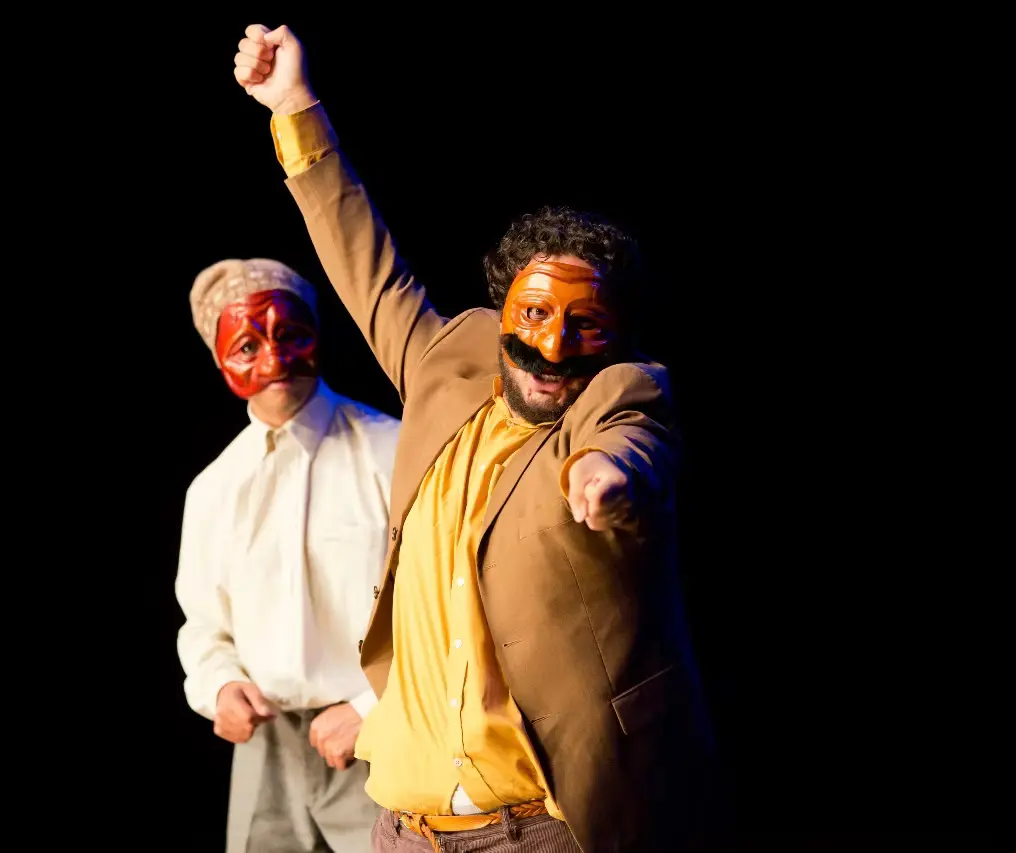
Experts refer to the work of Troupe Courage as Neo-Commedia dell’arte. They use newly developed, contemporary masks created by mask maker Den Durand. This makes them the only touring, contemporary Commedia company in the world.
The Commedia dell’Arte originated in the 16th century, during a time of political and economic instability. Groups of performers traveled from city to city, constantly finding new ways to survive—through humor, masks, and satire. Troupe Courage operates in the same spirit, but looks resolutely to the present. “We don’t do museum theater, and we don’t reenact stories from the past,” says Thomas van Ouwekerk of Troupe Courage. “We use traditional principles—such as masks, improvisation, physical theater, and direct interaction with the audience—to tell contemporary stories. The focus is not on the world of the past, but on people today.”
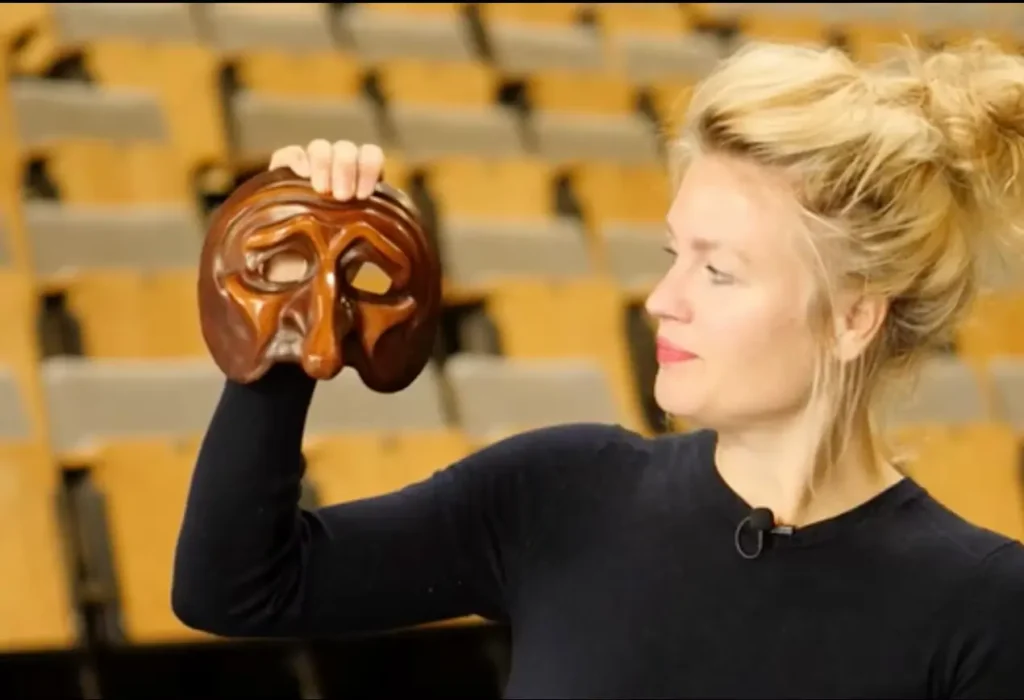
There are no scripts, no costumes, and no props. Only the masks are checked baggage. Those masks are instruments, not props. Mask maker Den Durand uses traditional techniques but draws inspiration from the modern world. Behind every mask lies an archetype—the old man, the domineering leader, the shy child—figures that are recognizable all over the world. “The mask forces you to play physically, directly, and honestly,” van Ouwekerk explains. “It’s only when an actor plays it that it comes to life.”
Improvisation as a Foundation
The actor’s body is the most important tool at Troupe Courage, and it is constantly being trained. His knowledge and experience in the fields of mime, pantomime, and improvisation are unparalleled in the Netherlands. But improvisation is not freedom without structure.
Van Ouwekerk explains that Troupe Courage often works with what is known as via negativa Technique: One performer stands on the stage, while another performer, from the audience, acts as a critical or subconscious voice. Everything the audience thinks but doesn’t say is brought to light. This results in a performance that is completely in the moment. The company also relies heavily on audience input: an actor is given a task, but the audience decides the details. “Often, perhaps 10 percent is set in stone, while 90 percent remains open,” says Van Ouwerkerk. “That requires actors to have a great deal of trust in one another, in their physical performance, and in their connection with the audience.”
In Search of Stories in Conflict Zones
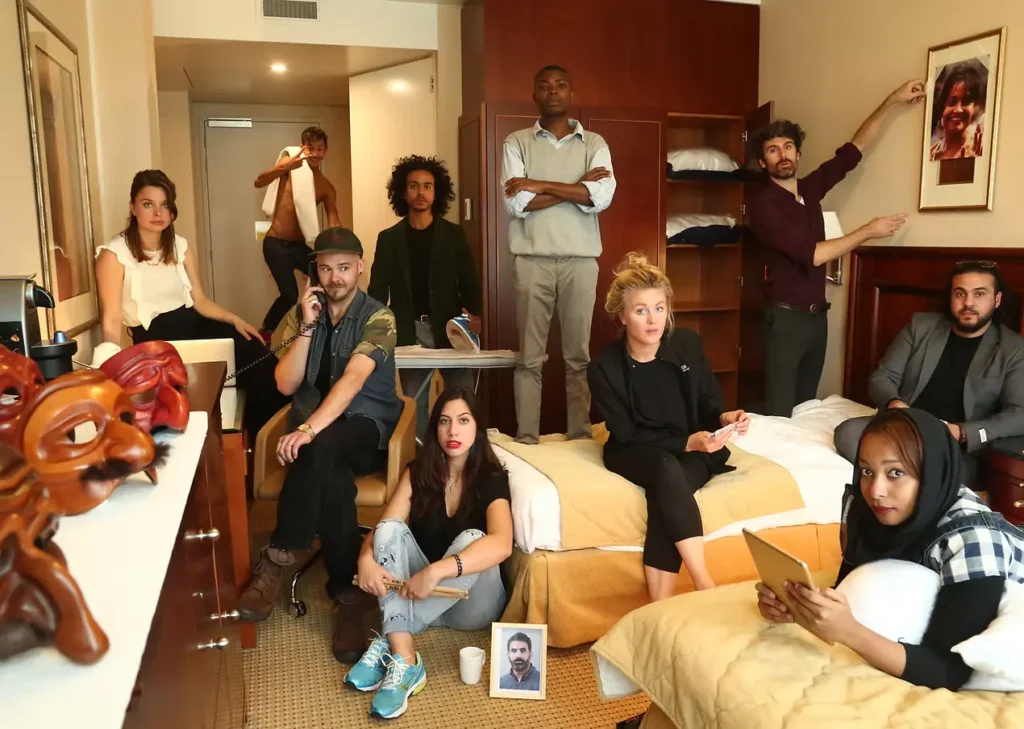
Troupe Courage travels the world like a group of explorers with a bag full of masks. They performed in a village square for a tribe in Shantiniketan (India), at the Freedom Theater in the Jenin refugee camp (Palestine), and at the community center in Accra (Ghana). There is no set strategy for choosing play areas. “Sometimes we’re invited, and sometimes we feel the need to go somewhere ourselves,” says Van Ouwekerk. “We’re not looking for perfect play areas, but for places where there’s a bit of friction, where things are alive, or where there’s a bit of tension.”
In hindsight, it’s striking that Troupe Courage often ends up in conflict zones. Although they never seek it out intentionally, the group is naturally drawn to it. Crises have always been fuel for breadwinners. As a result, Troupe Courage is rarely found on the red carpet, but rather on the street, in the bustling city, or in a completely deserted area.
Local residents and actors play a vital role in this. That’s how the neighborhood project came about in 2022 BB’s Hero at Balboaplein in Amsterdam-West, where young people from the neighborhood performed alongside the actors from Troupe Courage. “We shared stories about the people in the neighborhood themselves: the greengrocer everyone knows, the youth worker—the stories that normally remain hidden,” says Van Ouwekerk. “This way, a portrayal isn’t created about a place, but together with the people who live there.”
Language is never an insurmountable barrier in this regard. The power of masks and pantomime lies in the fact that they transcend language. At the same time, improvisations actually reveal the differences between cultures. A simple act like turning on the faucet looks different in the Netherlands than it does in Shantiniketan, India. “Everyone recognizes the old man or the old woman as an archetype, but every audience interprets that image differently based on its own reality,” said Van Ouwekerk. “It is precisely those differences—and that sense of recognition—that connect people to one another.”
“The mask doesn’t hide anything; on the contrary, it reveals more about the performer. It helps people become freer, more physical, and more courageous in their expression.”
Play as a Philosophy
For Troupe Courage, acting is not a technique but a way of life. Game intelligence isn’t about knowledge or ideas, but about action: how do you respond in a given situation? Every Courageist is like a young dog who really wants nothing more than to go outside to play, to explore new places, meet new people, and discover new things.
In workshops, the company shares that philosophy with others. The mask helps players act less from their minds and more from their bodies, imagination, and instincts. “What participants often discover is a sense of playfulness that they lost somewhere along the way,” says Van Ouwekerk. “The mask doesn’t hide anything; on the contrary, it reveals more about the performer. It helps people become freer, more physical, and more courageous in their expression.”
The group is fighting for a fundamental yet neglected right: the right to play. Play enhances creativity and resilience and fosters diversity in behavior, interactions, and connections.
Harlekino: A Solo Performance About Survival
An example of their productions is Harlekino, a solo performance by and starring Katrien van Beurden. After 25 years of traveling the world to put on plays with a suitcase full of commedia masks, she suddenly had to come to a standstill. Having just become a mother and been diagnosed with breast cancer, she wondered as she lay in the MRI scanner: How do you actually do that—just lie still?
The result is a wild, comical, and poetic solo performance. A kaleidoscopic journey through all the survivors she met along the way. With masks and music specially composed by Remy van Kesteren, she creates a cinematic storm of stories. She steps into the role of Harlekino, the iconic trickster, and shows that hope isn’t something to believe in, but something to do.
De Volkskrant reported that Van Beurden, in Harlekino shows how play can be a survival mechanism. The Theaterkrant called the performance “particularly moving” and praised its playfulness and imagination as its superpowers.
Katrien van Beurden: Knight of the Order of Orange-Nassau
In May 2023, Katrien van Beurden was appointed a Knight in the Order of Orange-Nassau in recognition of her tireless dedication to making theater relevant and indispensable. Director Titus Tiel Groenestege described her work as “a stunning, disarming, hilarious, confrontational, and incredibly powerful theatrical language using masks that is unique and groundbreaking in every respect.”