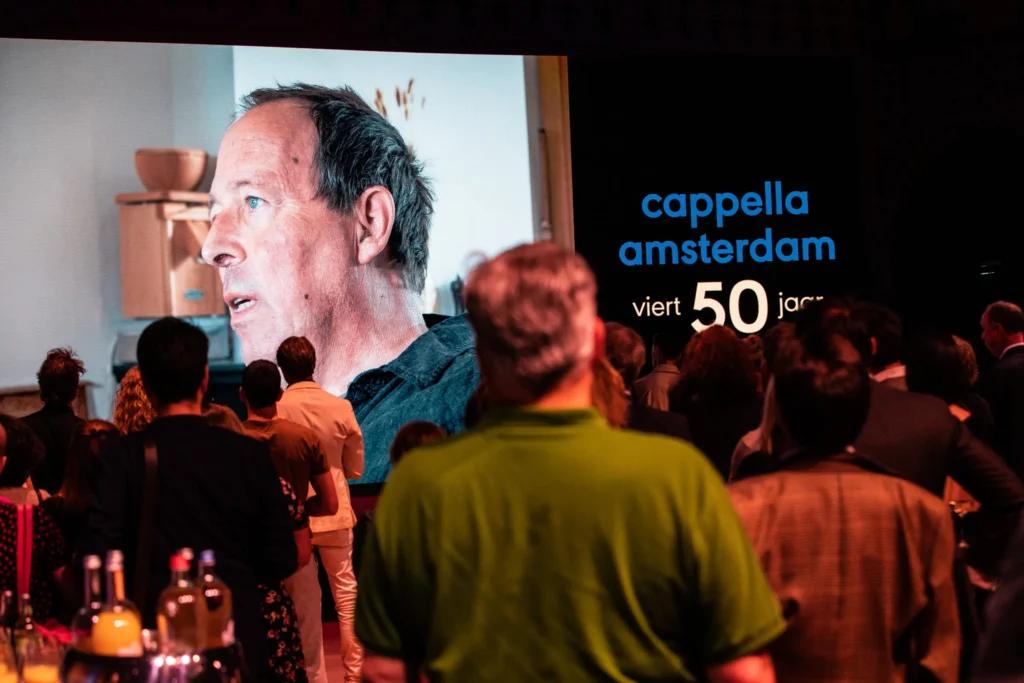

Composer, music critic and novelist Elmer Schönberger (Utrecht, 1950) wrote the new choral work De opstijging (The Ascent) for Cappella Amsterdam, which will have its world premiere on 12 November 2026 during the concert series Polderklanken. In this interview he talks about the eight-year road to the piece, his teacher Rudolf Escher, and why for him a text is “half the work.”
You alternately describe yourself as a writer, composer and musicologist. Does that order change from project to project, and which hat have you most enjoyed wearing lately?
“What am I now? All I can say is: I am whatever I’m doing. There was a famous chess player, the Russian Mark Taimanov. He was a great chess player, but he was also an important pianist. He formed a piano duo with his wife, and he said: ‘When I play chess, I’m on holiday from the piano, and when I play the piano, I’m on holiday from chess.’ In any given period he either played chess or played the piano, but never both at once or mixed together. And that’s really how I feel too. Now that I’m writing a book, I’m mainly a writer. Although I can’t wait to compose my next piece… but first, finish the book.”
As a critic, you wrote about other people’s music for more than thirty-five years. Do you listen to your own work differently from the work of others?
“Of course I ought to say ‘no,’ but I know my own music far better than any other music. I have a very personal, emotional bond with my pieces. Every composer will tell you that. I hope I’m critical of my own work, but of course you listen ‘differently.’ Not in the sense of being more or less lenient, but you simply relate to it differently. Perhaps it’s a bit like how you feel about your own child compared with someone else’s. I listen differently to my own music, but I hope that while I’m making it, I’m just as critical as when I listen to someone else’s music and write about it. But still, I can’t jump over my own shadow.”
As a young composer you took private lessons with Rudolf Escher, whose work is also being performed during Polderklanken. What did you take away from him, and do you think it can still be heard in your work?
“I don’t think it can be heard in my work, but he was extremely important to me. Escher taught at the Institute of Musicology in Utrecht, where he gave a course called ‘Aspects of Contemporary Music,’ from Stravinsky and Boulez to Peter Schat. If someone asked me what the most important thing was that I learned during my musicology studies, it would be his lectures. At a certain point I started taking private composition lessons with him.
I learned a great deal from him about the critical sense and precision with which he spoke about music. He was a highly self-critical man, perhaps too self-critical, and he could study a five- or six-minute piece for at least half a year. You learn an enormous amount from that, namely how much you can draw out of music. Musically speaking, I went in a very different direction from Escher, but I do believe I inherited my way of working from him: the methodical, precise side of it.”
How long did it take to compose De opstijging?
“Back in 2015 I wrote to a poet friend about a piece I was mulling over, involving ‘something’ with a hot-air balloon, ascending, thin air, silence and disappearance. That collaboration never got off the ground, but eight years later I made the piece I’d had in mind after all. I eventually composed it in short score between 27 March and 10 July 2023; the final score followed a year later. In May 2023 I told Daniel Reuss what I was working on, and that sparked his interest.”
What was the starting point for this piece, and what makes writing for choir different from writing for an instrumental ensemble?
“The text, of course. That’s half the work. I’ve always felt that strongly when writing vocal works. I started out playing the piano, but I don’t have many memories of that. When I was nine, I joined a church choir, and that’s what truly drew me into music. My view of singing isn’t very modernist: I believe that the vocal melodies you write should, in principle, be singable, close to where you once began as a human being. I’m not very fond of singing with lots of effects. That said, I thought it was wonderful when I heard new vocal techniques in the 1970s, because it was groundbreaking, but at some point you’ve heard enough of it. You’ll hear that way of singing, close to its origins, in De opstijging as well.”
For Schönberger, the text is more than just a starting point.
“The text is just as important as the music. I would never simply adapt or edit a text: either I choose a text, or I don’t.” On interpreting Lars Gustafsson’s poem The Balloonists, on which De opstijging is built, he says: “You think you’re on the same wavelength as a poet like that, but I don’t know what his interpretation is.” While researching the piece, Schönberger visited a hot-air balloon museum in France and the balloon exhibition at the Teylers Museum, and immersed himself in historical books on ballooning, even though the piece itself isn’t really about ballooning. “I think it’s like the ballast hanging from a hot-air balloon: once you’ve taken off and want to go further, you have to let it go. That’s how I eventually threw the thick books and the exhibitions overboard too.”
In your essays you argue that we should ‘learn to truly listen again.’ What would you like to pass on to a new generation of concertgoers about how to listen to contemporary choral music?
“First of all: don’t draw such a sharp line between contemporary and non-contemporary. Be curious; better still, have extra reason to be curious about what people of your own generation have to say musically. I think making music and listening to music have nowadays been pulled very much into the sphere of consumption. Realise that a great deal of thought, time and feeling has been invested in music, and invest in your listening as well. It’s an old-fashioned, classical Bildung ideal: those who make it put something into it, and the listener puts in a different kind of energy, namely the effort to understand it. That’s the opposite of consumerism, which says: make something I can understand straight away and that revolves around my feelings. I believe it should be about what an artist wants to convey. Try to open yourself up to it, and be committed.”
Schönberger is also happy to give listeners of De opstijging something to hold on to, in the form of a narrator and archival images: “I believe De opstijging is easy to follow even without preparation, and the texts can be read afterwards if you like. In any case, we’re trying to make it so that you’re simply carried along.”
With De opstijging, Elmer Schönberger adds a distinctly personal work to the Dutch choral repertoire: a piece that was eight years in the making, in which text and music are inseparably linked. Want to know more about the man behind this work, his years as a music critic and his life as a novelist? Read the portrait: Elmer Schönberger: composer, critic, writer.
Want to hear De opstijging live? Check the Polderklanken concert dates and book your tickets.
Stay up to date on new programmes and interviews like this one. Sign up for the newsletter.
Listen to Cappella Amsterdam on Spotify and YouTube in the meantime.