In the summer of 1532, a boy was born in Mons, in present-day Belgium, who would permanently change the course of music history: Orlando di Lasso. From an early age, his extraordinary singing talent stood out. Legend has it that his voice was so remarkable that, as a choirboy, he was “bought away” several times by noble families eager to claim him for their own chapels. Eventually, he arrived in Italy, the beating heart of Renaissance music.
There, amidst the vibrant musical centers of cities such as Rome and Naples, the young Lasso became immersed in refined polyphony and the expressive Italian style. It formed the foundation of a career that would take him through royal courts and cathedrals across Europe. He earned acclaim as a virtuoso singer, but above all as the composer of an unparalleled body of work encompassing both sacred masses and secular madrigals.
His life reads like a journey through the musical map of the 16th century: from the churches of Italy to the palaces of Bavaria. Everywhere he went, he demonstrated how music could become a language that transcends borders. Lasso’s work reflects that cosmopolitan vision: he was a composer who united the voices of Europe in sounds that continue to resonate today.
Style evolution
In 1556, Orlando di Lasso was appointed Kapellmeister at the court of Albert V, Duke of Bavaria in Munich, a position he would hold until his death in 1594. The Bavarian court was an important cultural center and offered Lasso the ideal environment in which to develop and express his musical talents. His years in Munich marked a period of extraordinary creativity and productivity. He composed an enormous number of works, including motets, madrigals, chansons, masses, and lamentations.
Lasso’s style is characterized by his masterful command of both counterpoint and homophony. He combined these techniques with deep emotional expression, making his music both technically brilliant and powerfully expressive. One of the defining aspects of his style is his use of text painting, in which the music illustrates the meaning of the words. This can be heard clearly in his madrigals, where musical gestures depict words such as “rising” or “falling.”
Major Works
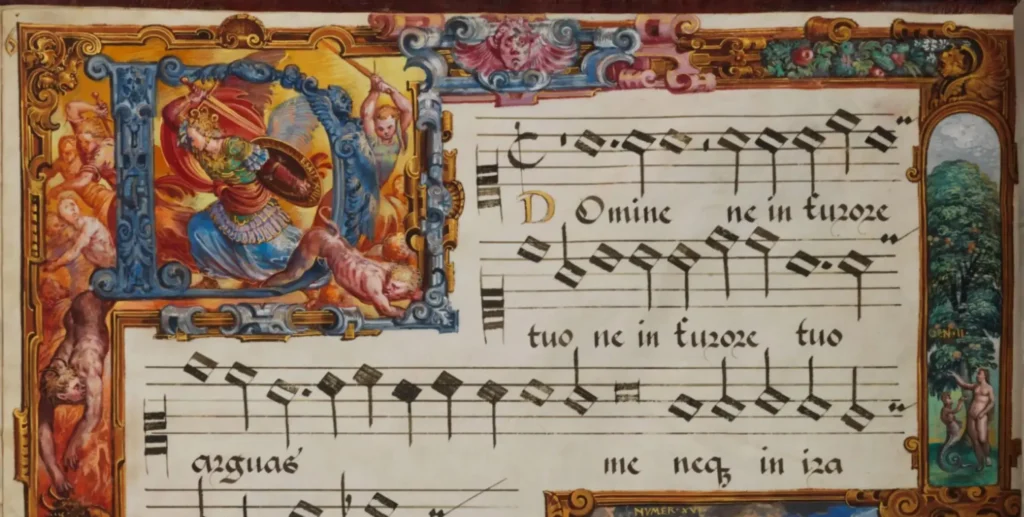
Orlando di Lasso’s oeuvre is vast and diverse. Among his most celebrated works are the motets collected in Patrocinium Musices and the madrigals in Libro de Villanelle, Moresche et altre canzoni. His Penitential Psalms, written for Albert V, Duke of Bavaria, form a profoundly moving cycle of psalms filled with both liturgical and emotional depth.
Another masterpiece is Lagrime di San Pietro, a cycle of twenty madrigals and a motet composed on texts by Luigi Tansillo. Written shortly before his death, this work stands as Lasso’s musical testament — a legacy imbued with devotion and demonstrating his supreme mastery of polyphony. The voices intertwine like strands in a braid of sound, each carrying its own emotional weight. It is a farewell filled with consolation, yet also deep emotional intensity.
Legacy
Orlando di Lasso’s contribution to music is immeasurable. He bridged national styles and created a synthesis that made his music universal. His masterful command of both sacred and secular genres, combined with his emotional depth and technical brilliance, established him as one of the towering figures of the Renaissance. His legacy lives on not only in the music he composed, but also in the countless composers inspired by his work. To this day, his music remains a source of beauty, inspiration, and admiration for musicians and listeners around the world.