At first glance, the pianola looks just like a piano. But if you look more closely, you’ll discover a remarkable hybrid: half musical instrument, half mechanical player. Around 1900, this device became the symbol of an era in which craftsmanship and industry came together and embraced one another. While concert halls filled up with audiences eager to see the great virtuosos, the pianola brought that same repertoire into people’s living rooms. Suddenly, even people with no piano skills at all could play Chopin études, Wagner excerpts, or Debussy preludes, and the parlor was transformed into a private concert hall.
The pianola, the gramophone, the Walkman
The word pianola is a contraction of piano and the diminutive suffix -ola, which was more commonly used in the United States at the end of the 19th century to refer to devices that were “small” or “mechanical.” The Pianola brand, introduced by The Aeolian Company in 1895, became a generic term. The name quickly became established in Dutch as well and took on the status of a generic term, similar to words like “gramophone” or “Walkman.”
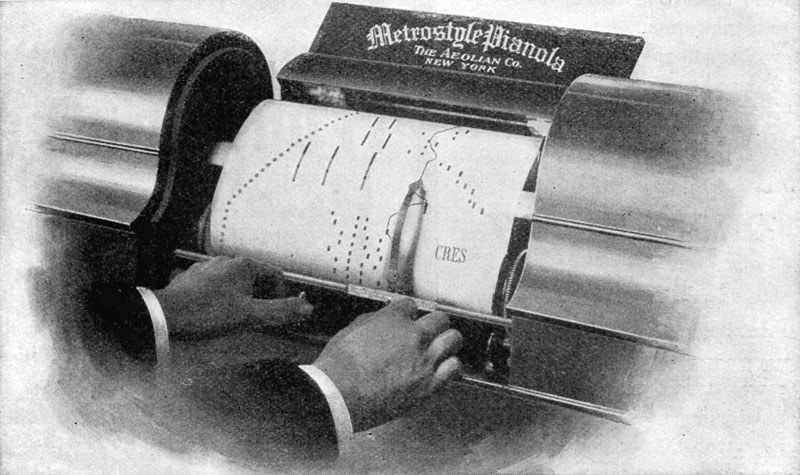
The Metrostyle – Aeolian Company, New York, Fall 1903, via pianola.org
Musicological Background
The pianola belongs to the family of pneumatic instruments. The mechanism is air-powered and operated by pedals that set rollers with perforated paper in motion. Each perforation corresponds to a key on the piano. Unlike with a barrel organ, the performer is not completely sidelined: the player can influence the tempo, dynamics, and phrasing by varying the pressure on the pedals and the registers. Thus, the pianola straddles the line between automatic and expressive music-making. You could compare the role of the performer to that of a DJ behind a mixing board: the material (the tracks or notes) is fixed, but through timing, dynamics, and accents, a performance emerges that sounds different every time.
History
Although the pianola itself did not emerge until the end of the 19th century, the instrument is part of a much older tradition of mechanical musical instruments. Medieval carillons and organs already used rolls or cylinders. During the Renaissance, harpsichord builders experimented with automatic playing mechanisms. During the Baroque period, organ clocks and musical automata became popular at European courts, often as a demonstration of technical and scientific ingenuity.
Romanticism and the Early 20th Century
The heyday of the pianola was between 1895 and 1930. During the Romantic period, the piano took center stage as an instrument of personal expression, but at the same time, the demand for music in the home grew steadily. The pianola offered a solution: entire symphonies, operas, and chamber music pieces could be played back in transcriptions. Composers such as Stravinsky, Busoni, and Hindemith even wrote original works for the pianola, treating the instrument not as a substitute but as an independent medium of sound. Stravinsky’s Étude for Pianola (1917) is considered a milestone in this regard.
20th-Century and Contemporary Music
With the rise of radio and the gramophone, the pianola lost its role as a domestic music medium in the 1930s. Nevertheless, the instrument continued to be used in specialized circles. Today, historical piano rolls are used to analyze performances by greats such as Rachmaninoff and Paderewski: their playing was captured with a precision that ordinary recordings could not match. In contemporary music, composers and sound artists sometimes turn to the pianola because of its hybrid status between human and machine, and the unexpected sound combinations that result from it.
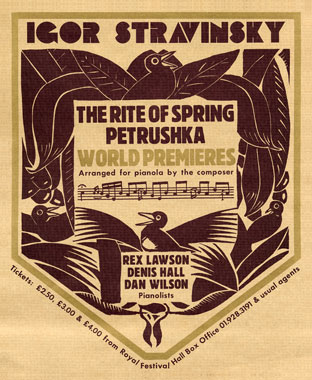
A concert flyer from the Pianola Institute, based on the design of Stravinsky’s piano rolls
Stravinsky and the pianola
Igor Stravinsky had a particular interest in the pianola. He did not see the instrument as a replacement for the pianist, but as a new medium with its own possibilities. In 1917, he wrote the Étude for Pianola, in which he explored the precision and motor skills involved in rolling techniques. Even more striking is his use of the pianola in Les Noces (1914–1923), in which he sometimes had the piano parts played by a pianola in order to maintain the relentless rhythm and strict repetition. Stravinsky appreciated the pianola precisely because of its “inhuman” uniformity and lack of romantic subjectivity: qualities that fit seamlessly with his aesthetic of clarity and objectivity.
For those who want to hear this for themselves: the recording of Étude pour Pianola by Rex Lawson, a specialist in pianola repertoire, provides a vivid picture of how Stravinsky approached the instrument. Modern versions of Les Noces Performed with a pianola instead of four pianos, this piece demonstrates just how uncompromisingly precise Stravinsky intended his rhythms to be.
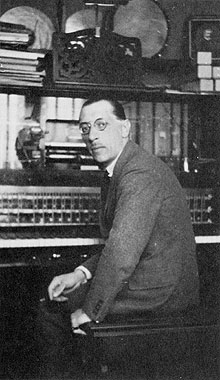
From “Stravinsky in Pictures and Documents” by Vera Stravinsky and Robert Craft. Hutchinson, London, 1979.
And so...
The pianola is more than just a curiosity from the living rooms of the early 20th century. The instrument illustrates how technology can transform, democratize, and redefine the experience of music. For classical music lovers, the pianola opens a window onto an era when virtuosity, reproduction, and innovation came together.