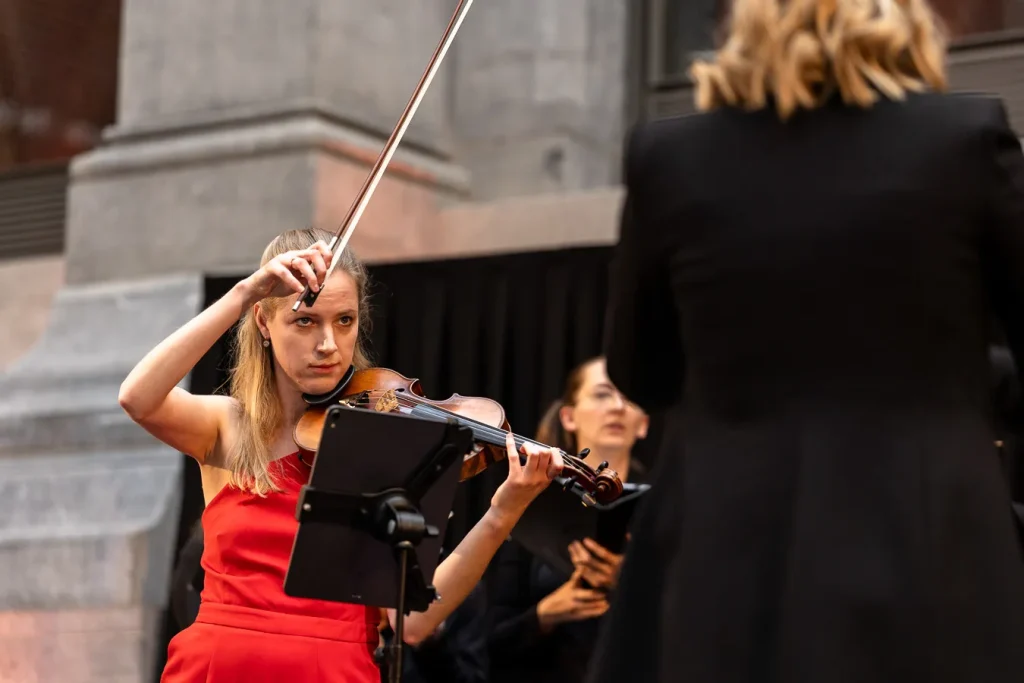
Violinist Merel Vercammen and cellist Maya Fridman have for years formed a duo that refuses to be confined to musical pigeonholes. Their album Rejoice, recorded with Cappella Amsterdam under the direction of Daniel Reuss, is an ode to nature, to sound, and to connection. The title suggests joy, but it is a joy with depth — one that gains extra meaning after silence, loss, or reflection.
Fridman on the title:
“The title Rejoice, taken from Gubaidulina’s composition, refers for me to the idea that even in the most tragic circumstances you can still find the strength to celebrate — music, nature, and the connections we share with the world around us. The piece reminds me that joy is not the absence of suffering, but a force that can arise from within.”
The programme brings together composers who see nature as a source of inspiration: Sofia Gubaidulina, Pēteris Vasks, and Maxim Shalygin. Works that each bear witness, in their own way, to wonder, comfort, and a search for something greater. Vercammen and Fridman have consciously sought out the poetic and philosophical layers in each work:
“Every work on the album is profound, poetic, and philosophical, and invites a thorough form of reflection,” says Fridman.
Rejoice is therefore not a final chord, but a breath — a reminder that music, like nature, lives in cycles of tension and release. We spoke with Vercammen and Fridman about their collaboration, the recording days, and their interpretation of the works.
How did your collaboration actually begin?
Vercammen: “Fridman and I actually started playing together as a violin-cello duo in quite an unusual way: at the beginning we only played free improvisations together, because I was looking for duo partners for my album of free improvisations and I found a kindred spirit in Fridman. It was only after quite some time that written music was added. Playing works by composers of today who also capture the current spirit of the times therefore suits our duo well. Vasks and Gubaidulina also make use of a kind of written-out improvisations in the works on our album. With Maxim Shalygin we have above all a personal connection: he wrote the work Angel especially for us at the beginning of the coronavirus pandemic, when people still held hope that the reduction in human activity would be good for nature, and that we would come to relate to nature differently in the future. I found it particularly valuable to be able to give expression to that feeling together with a composer during such an uncertain time. Above all, we were enormously looking forward to surrounding ourselves with the beautiful sound of Cappella Amsterdam and working with them on Plainscapes.”
Fridman: “Making an album as a duo requires a shared musicality and mutual understanding. Because we had improvised together so much, we developed a deep familiarity with each other’s musical language, which gave us a solid foundation for approaching these works. We both felt the need to immerse ourselves completely in the musical depth of Gubaidulina, Pēteris Vasks, and Maxim Shalygin. Every work on the album is profound, poetic, and philosophical, and invites a thorough form of reflection. The piece by Gubaidulina had been on our wish list for a long time. It is not easy to perform and also demands great concentration from the audience — almost like a meditation we perform together. That was also our experience during the concerts preceding the recording. In the studio we hoped to recreate this atmosphere of solemn contemplation. Plainscapes has a comparable quality, though here our sounds merge with the incredible voices of Cappella Amsterdam, which adds an extra dimension to the experience.”
Why Cappella Amsterdam?
Vercammen: “I had always been greatly impressed by Cappella Amsterdam, and in consultation with Fridman we decided to approach Daniel Reuss to ask whether Cappella Amsterdam would like to record this piece with us. Cappella Amsterdam was our dream artistic partner for this project, which we were able to realise thanks to a crowdfunding campaign. Future artistic director Krista Audere was also involved in the preparations for the recordings — she knows Vasks personally and even spoke with him about this project, so that was a valuable addition.”
How did the recording sessions go?
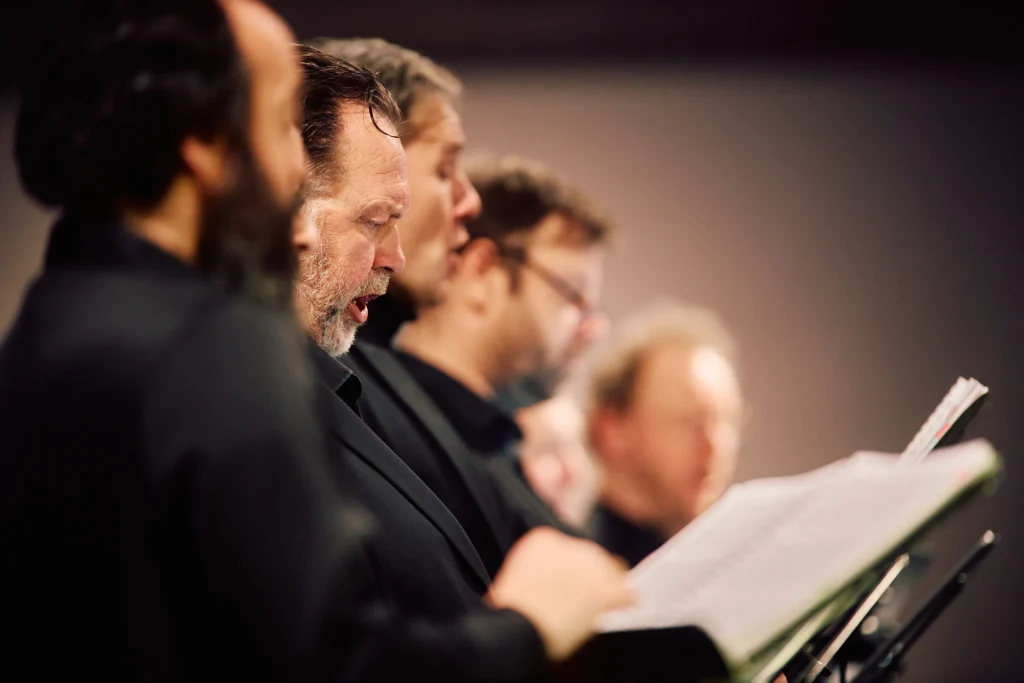
Vercammen: “We were most surprised by the cold; the church had indicated that there would be heating and that the space could be brought to 18 degrees, but unfortunately the heating system turned out to be too noisy for an album recording. It was winter and wet snow was falling outside, so it cooled down very quickly. Yet everyone gave everything they had to capture the piece as beautifully as possible — I found that wonderful and I am enormously grateful for it.”
Fridman: “I found the collaboration with the choir and our recording team fantastic! Despite the cold, the sounds from outside (the Pieterskerk is situated right in the centre of Utrecht), and the tight schedule, we were tremendously supported by everyone’s focus and enthusiasm. That is something I will never take for granted.”
The character of the album
Vercammen: “It is a contemplative album of contemporary music by composers inspired by nature and/or spirituality. During Vasks’ Plainscapes, nature awakens on the plains of Estonia. You hear a vast open landscape, birdsong, and it builds toward a climax of sunbeams.”
Fridman: “I think that finding a personal connection with the spiritual ideas of the composers gives a great deal of insight into how their works can be brought to life. It becomes less about technique and musical expressiveness and more about embodying a particular way of being. For me it is above all about freedom — a freedom that reveals itself so effortlessly when you are in nature. Some of these symbols can be found in the music itself: for instance the image of the bird in Vasks’ Plainscapes. In Gubaidulina’s work it can be seen in the titles of the various movements, which refer to the underlying concepts that shape the piece.”
Vercammen on the title: “For me personally it is above all a tribute to Sofia Gubaidulina, one of the greatest composers of our time. Gubaidulina passed away on the day after we had finished the album. Rejoice is a monumental work for violin and cello that also offers a very intense listening experience in live performance. For me, learning this work brought enormous artistic satisfaction, and Fridman was the natural person to play it with. The spiritual character of the piece suits her very well, and she brings exactly the right feeling and depth to all the cello solos. Sometimes I almost forgot to come in myself afterwards.”
Fridman on the title: “The title Rejoice, taken from Gubaidulina’s composition, refers for me to the idea that even in the most tragic circumstances you can still find the strength to celebrate — music, nature, and the connections we share with the world around us. The piece reminds me that joy is not the absence of suffering, but a force that can arise from within.”
Vercammen on the recording location: “We chose the Pieterskerk because it is a place where Cappella Amsterdam records regularly and where the singers feel completely at home. Especially in a contemplative work like the Vasks, I think that sense of ease is very important.”
Personal reflection and artistic mission
Vercammen: “Because the classical canon consists primarily of male composers whom we have heard very often and who are played frequently, these composers benefit from a ‘joy of recognition’ effect, and people want to listen to that music even more. There are quite a few talented female composers who have never had the space to develop their careers. By shining a light on some of them, the balance might perhaps be restored a little. I enjoy discovering music by composers who deserve more attention. Incidentally, on my albums a natural balance between male and female composers has always emerged. And in Sofia Gubaidulina’s case, the above of course does not apply — thanks to Gidon Kremer she has gained worldwide renown.”
Vercammen on impact: “I always hope that my projects add something to the world, even if it is small and within the niche of classical music: a world premiere (such as this recording of Angel), shining a spotlight on an unknown composer, presenting a new intellectual connection or artistic idea, creating new music through improvisation, or sometimes offering a fresh perspective on a more familiar piece through a particular interpretation.”
Vercammen on inspiring female composers: “Not necessarily because they are women, but I found the life story of the sisters Lili and Nadia Boulanger extraordinarily intriguing, for instance, and that inspired me to make the album The Boulanger Legacy, which also features Grażyna Bacewicz (a pupil of Nadia Boulanger), among others. Both Lili Boulanger and Grażyna Bacewicz should, in my view, belong to the classical canon. I am glad to see them appearing more and more frequently on concert programmes. I also love collaborating with wonderful composers of today who happen to be women; I commissioned Mathilde Wantenaar, for example, to write a violin concerto and an opera about Einstein for my festival SNAAR.”
Fridman on female composers: “I collaborate intensively with composer Saskia Venegas, whose work is very much of the present and addresses many social themes. In her solo cello work Medusa she draws inspiration from the myth of Medusa, a priestess who was raped by the god Poseidon and as punishment was transformed into a monster and banished to a lonely island. I also collaborate with wonderful composers such as Fjóla Evans, Wilma Pistorius, Karen Tanaka, and Missy Mazzoli.”
Fridman on artistic vision: “As a cellist and creator I feel enormously privileged to be surrounded by so many wonderful artists. In my work I seek artistic concepts that open up space for dialogue between cultures and creative disciplines. At the same time I enjoy reflecting on classical works from previous centuries that still carry a powerful and relevant message. My wish is that this contributes to a classical music landscape with greater openness, imagination, and connection.”
Order the album Rejoice by Vercammen and Fridman with Cappella Amsterdam. Available via all streaming platforms and as a CD.