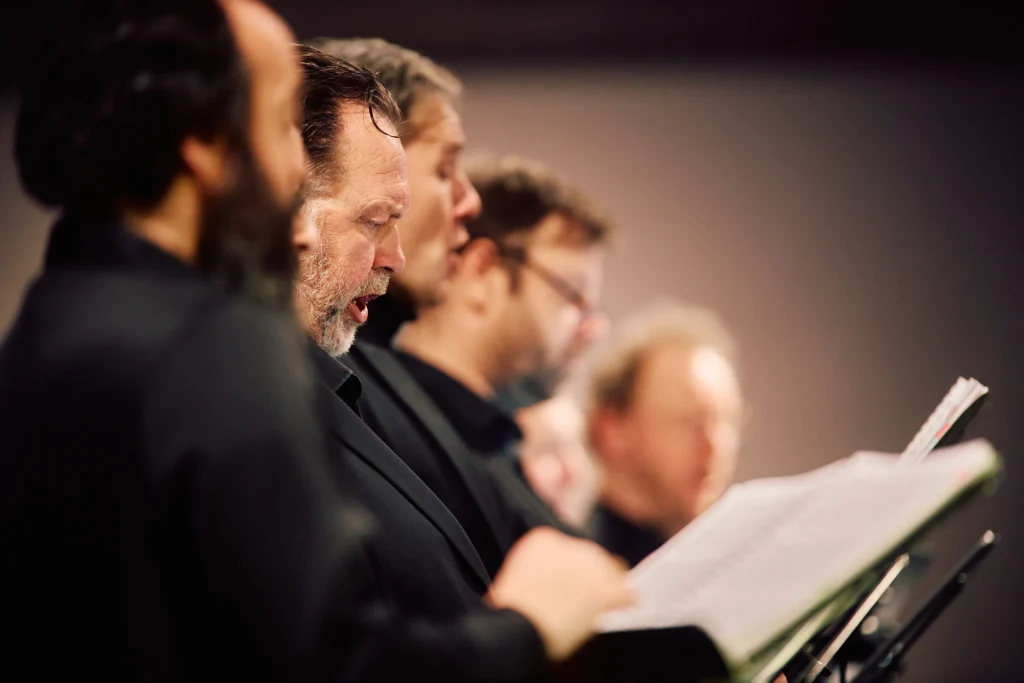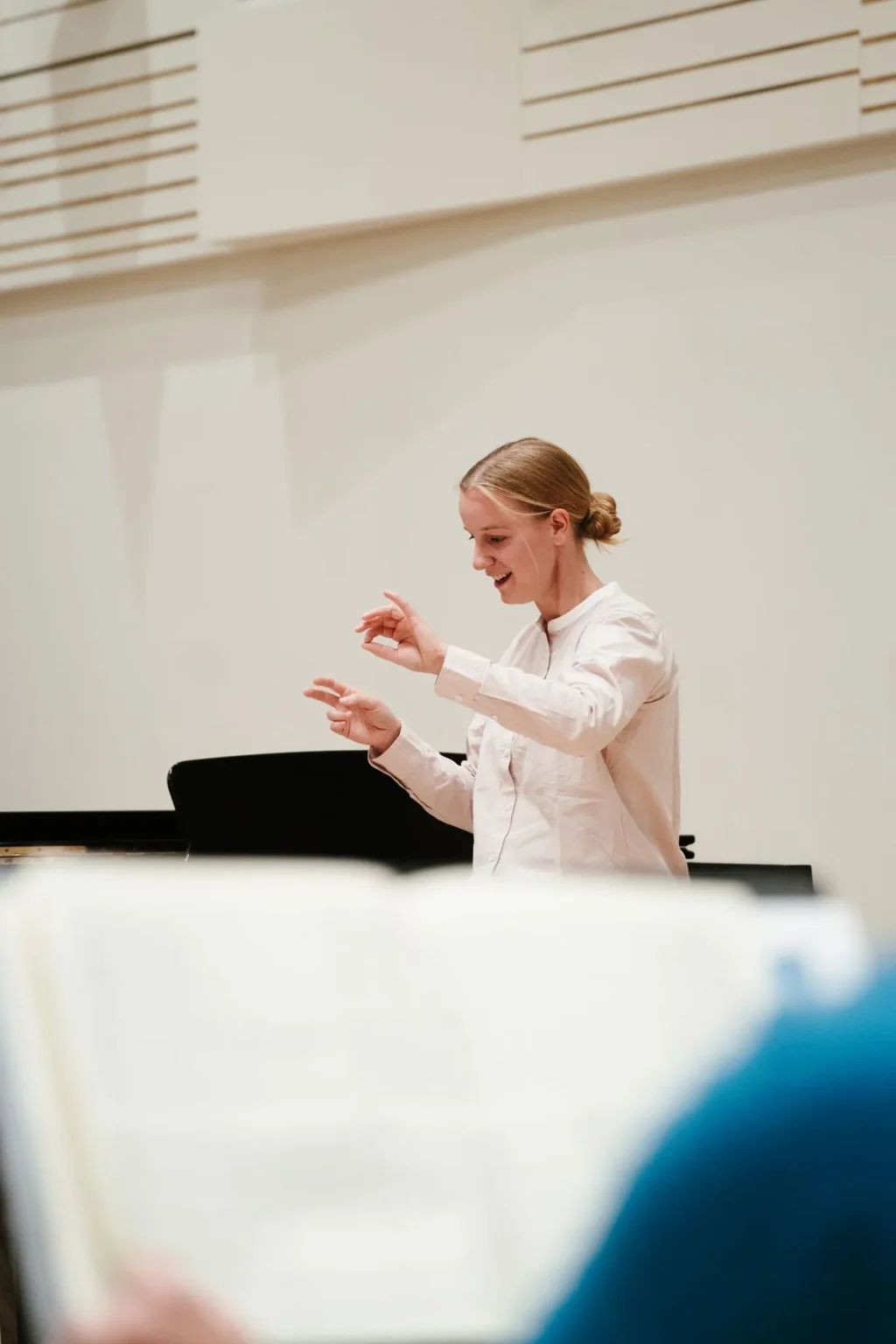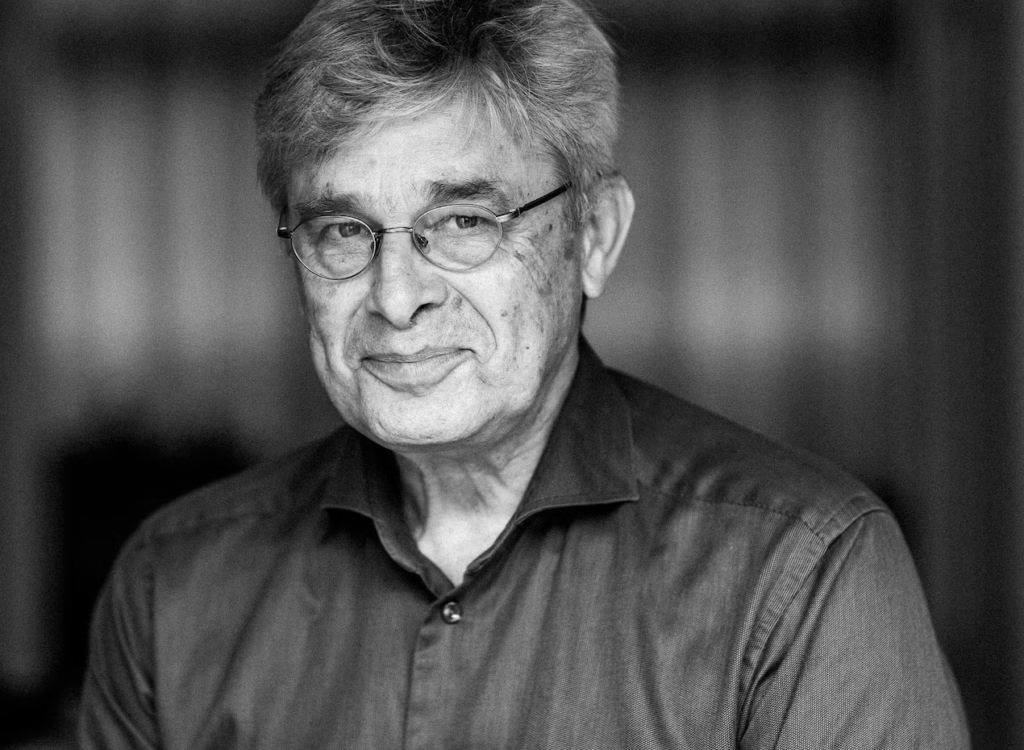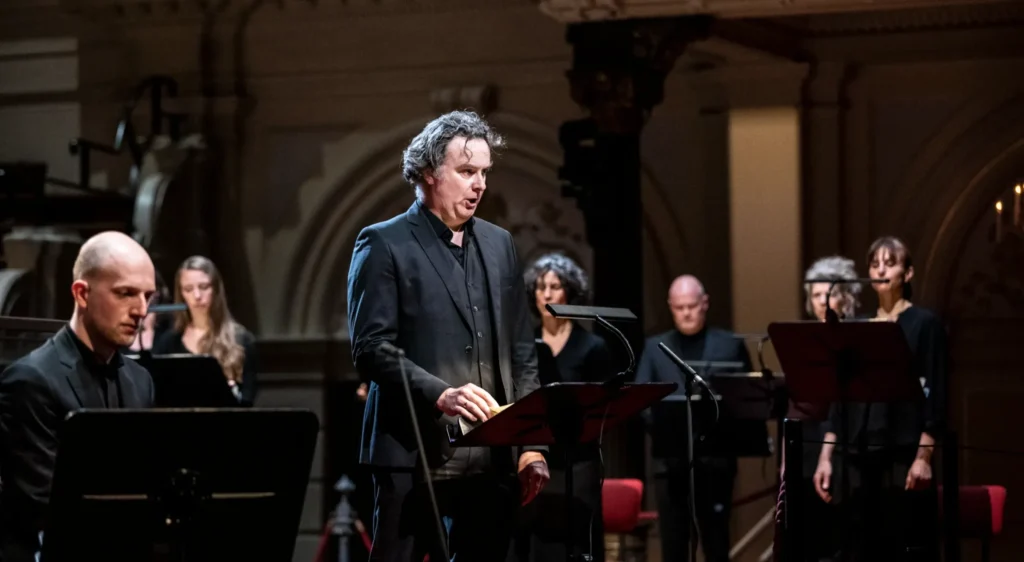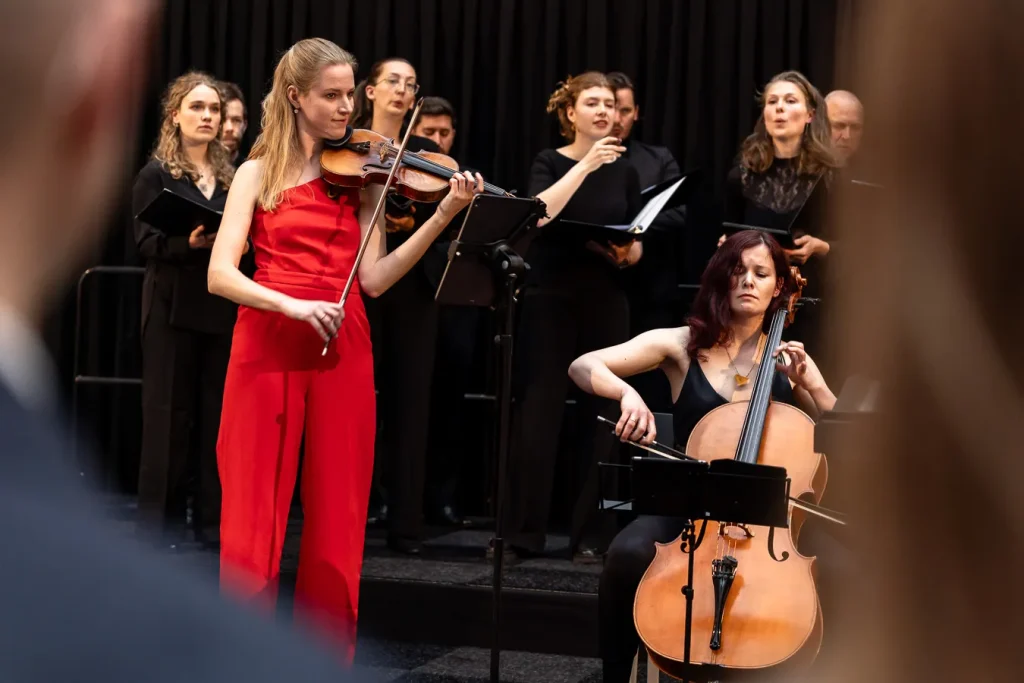
What does it mean to perform music created by composers who see nature as their greatest source of inspiration? On the new album Rejoice, violinist Merel Vercammen and cellist Maya Fridman explore with Cappella Amsterdam, under the direction of conductor Daniel Reuss, how music can serve as a mirror of Mother Earth. They chose three works in which the connection with nature and the spiritual takes on a different form each time: Sofia Gubaidulina, Pēteris Vasks, and Maxim Shalygin. The album, released on 17 October 2025, was recorded in the monumental Pieterskerk in Utrecht.
Een bijzondere samenwerking
The title of the album refers to the impressive Rejoice! Sonata for violin and violoncello by composer Sofia Gubaidulina, a work that pulses between whispering stillness and outbursts of glory. Vercammen explains:
“Rejoice is a monumental work for violin and cello that also offers a very intense listening experience in live performance. For me, learning this work brought enormous artistic satisfaction, and Fridman was the natural person to play it with. The spiritual character of the piece suits her very well, and she brings exactly the right feeling and depth to all the cello solos. Afterwards I almost forgot to come in myself.”
The Vercammen–Fridman duo has been collaborating for years in an unusual way: initially only through free improvisation, and only later with written music. This made the works of Gubaidulina, Vasks, and Shalygin feel like a natural next step. Vercammen:
“Maya and I actually started playing together as a violin-cello duo in quite an unusual way: at the beginning we only played free improvisations together, because I was looking for duo partners for my album of free improvisations and I found a kindred spirit in Maya. It was only after quite some time that written music was added.”
Fridman adds:
“Making an album as a duo requires a shared musicality and mutual understanding. Because we had improvised together so much, we developed a deep familiarity with each other’s musical language, which gave us a solid foundation for approaching these works. Each piece on the album is profound, poetic, and philosophical, and invites a thorough form of reflection.”
Merel Vercammen
Vercammen (Nijmegen, 1988) is a Dutch violinist who stands out for her versatility and curiosity. She began violin lessons at the age of five and at fifteen enrolled at the Utrecht Conservatory under Eeva Koskinen. She later continued her studies at the Royal College of Music in London, where she graduated with distinction.
Vercammen has performed worldwide, including in prestigious venues such as the Concertgebouw in Amsterdam, the Elbphilharmonie in Hamburg, and the Wigmore Hall in London. She is widely praised for her understanding of musical structure, nuance, and expression, beyond mere technique. Even in her earliest recordings she was celebrated for her emotional impact: the listener “rolls from one astonishment to the next.”
Alongside her classical repertoire, she is active in improvisation and in championing female composers. She also develops interactive music festivals, such as the SNAAR Festival at TivoliVredenburg.
Maya Fridman
Fridman (Moscow, 1989) is a Russian cellist, singer, and composer who lives and works in the Netherlands. She began her musical training at a young age in Moscow and later graduated with distinction from the Conservatorium van Amsterdam under Dmitri Ferschtman.
Fridman is celebrated for her ability to find deeper meaning in music and to express it through a powerful emotional performance. She embraces the transformative power of music, using it to help her audiences open their imagination by briefly carrying them to another dimension. She has won several awards for this, including the Dutch Classical Talent Award in 2019.
Three compositions
Rejoice features three works that complement each other:
Pēteris Vasks (1946) – Plainscapes
A horizon of sounds in which choir, violin, and cello together evoke the feeling of sweeping fields and awakening nature. Vercammen recalls how the process of searching for the right sounds and harmonies within improvisation unfolded:
“Plainscapes consists of three vocalises, and the third builds toward a climax in which nature awakens. Remarkably, the choir is also required to improvise at that point; they have to make bird sounds. It took some effort to turn that into a unified ‘bird choir’… In the end we let everyone trust their intuition, and that always works best with improvisation — it became a beautiful awakening forest with birdsong, over which Maya and I could play with (partly) written-out improvisations.”
Maxim Shalygin (1985) – Angel: version for violin and cello
An intense duet in which violin and cello circle each other like shadow and light. A work that underlines that sensitivity is decidedly not the opposite of strength. Vercammen speaks about her personal connection with Shalygin, who wrote Angel especially for her and Fridman:
“At the start of the coronavirus pandemic, people still held hope that the reduction in human activity would be good for nature, and that we would come to relate to nature differently in the future. I found it particularly valuable to be able to give expression to that feeling together with a composer during such an uncertain time.”
Sofia Gubaidulina (1931–2025) – Rejoice! Sonata for violin and violoncello
A sweeping sonata that moves from stillness to jubilation, with gliding harmonics, grinding double stops, and long, taut melodic lines. The fact that this title also became the name of the album is no coincidence: for Vercammen it is above all a tribute to Sofia Gubaidulina. She explains: “Gubaidulina passed away on the day after we had finished the album. Rejoice! is a monumental work for violin and cello that also offers a very intense listening experience in live performance. For me, learning this work brought enormous artistic satisfaction, and Maya was the natural person to play it with. The spiritual character of the piece suits her very well, and she brings exactly the right feeling and depth to all the cello solos. Sometimes I almost forgot to come in afterwards.”
A preview of the interview
In the interview, which will be available to read here shortly, Vercammen and Fridman talk about their collaboration and interpretation of specific works, the recording day at the Pieterskerk in Utrecht, their impact on the classical music landscape, and much more.
Fridman:
“I believe that a personal connection with the composers’ spiritual ideas gives a great deal of insight into how their works can be brought to life. It becomes less about technique and musical expressiveness and more about embodying a particular way of being. For me it is above all about freedom — a freedom that reveals itself so effortlessly when you are in nature.”
Vercammen:
“There are quite a few talented female composers who have never had the space to develop their careers. By shining a light on some of them, the balance might perhaps be restored a little. I enjoy discovering music by composers who deserve more attention.”