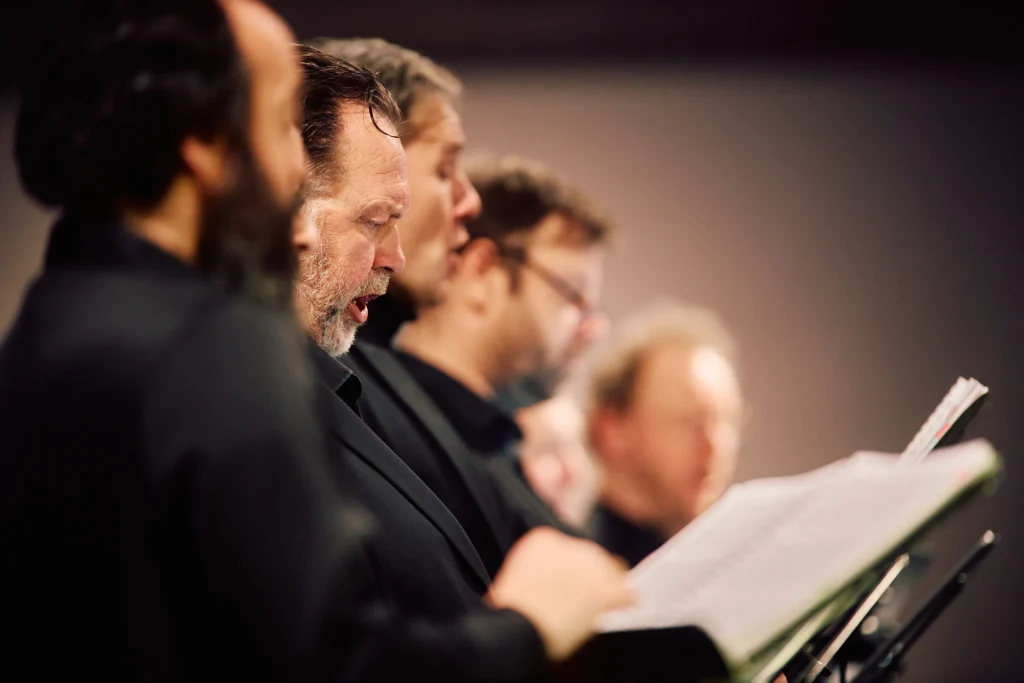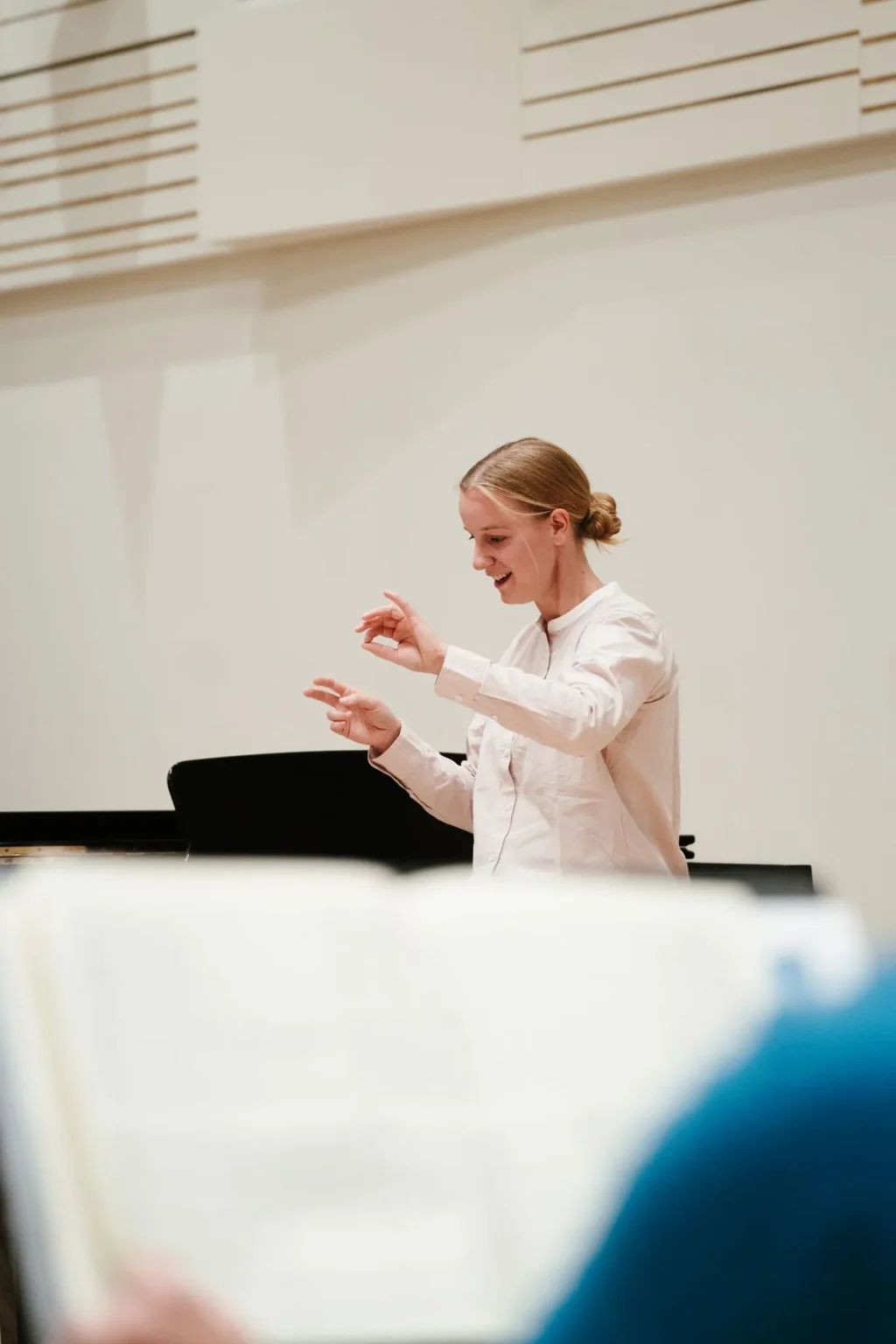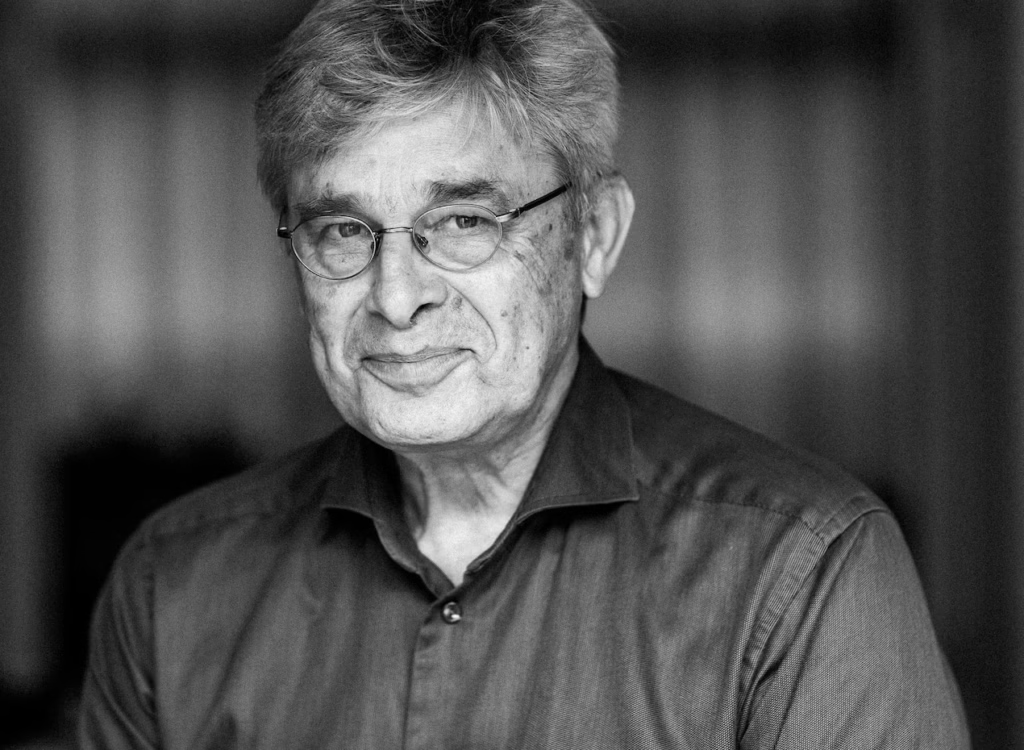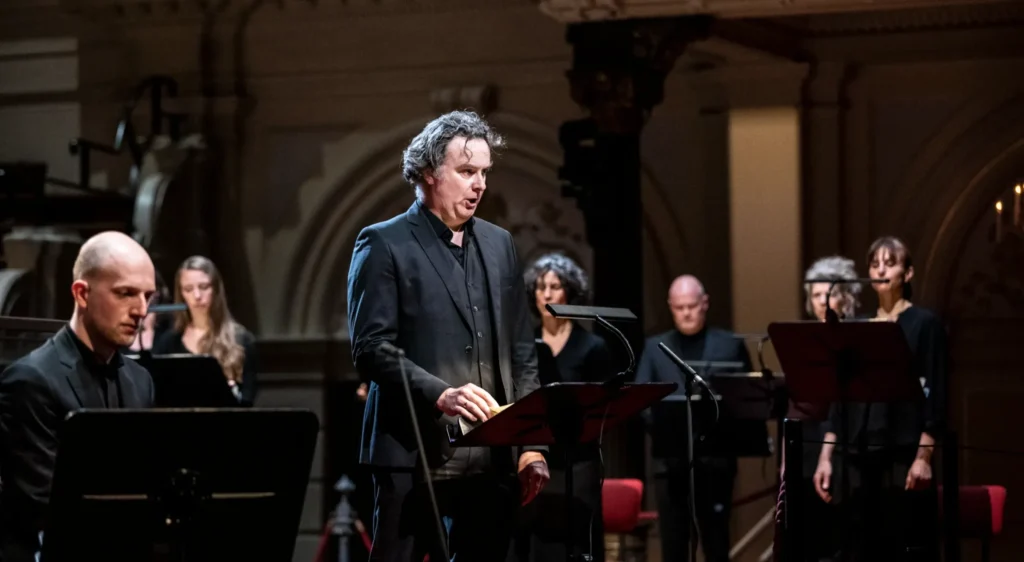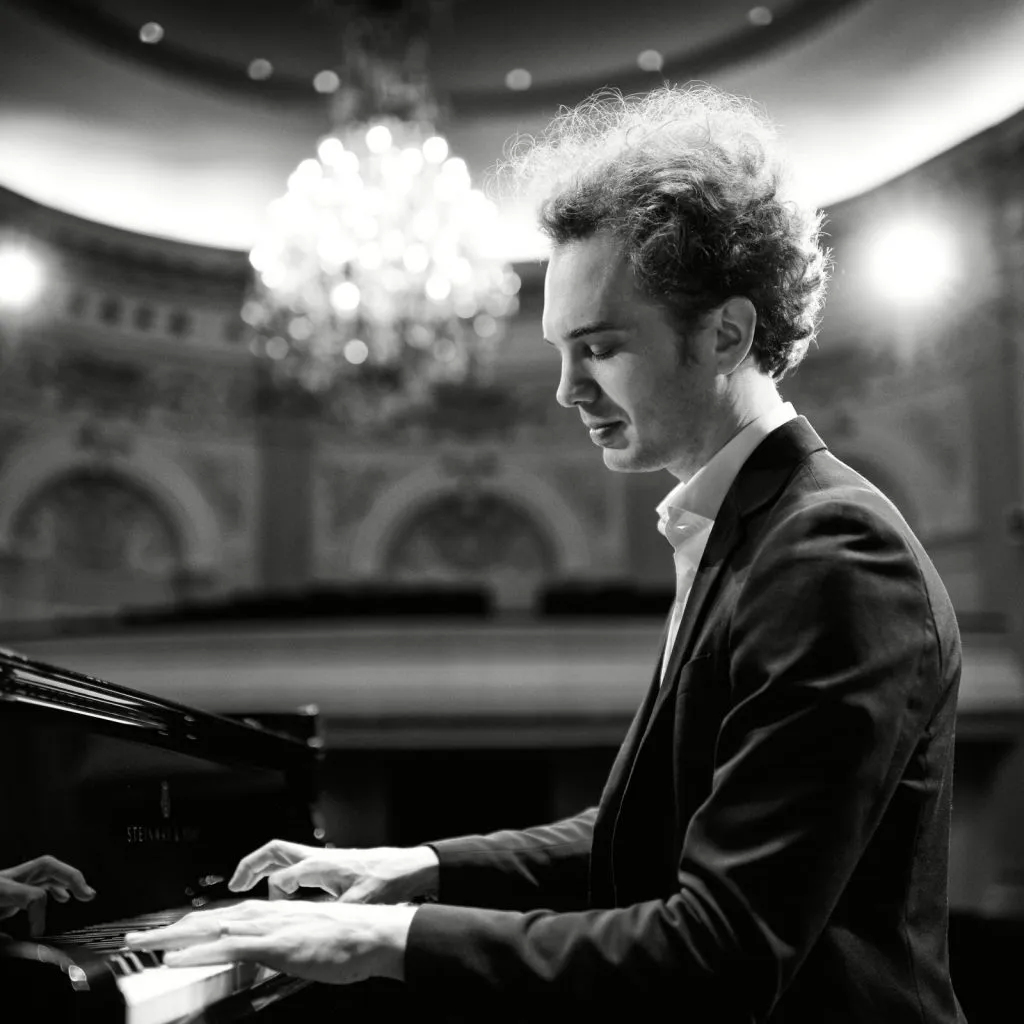
During the concert Gespiegeld (“Mirrored”), Cappella Amsterdam and pianist Julien Libeer joined musical forces once again, following the success of The Well-Tempered Songbook. Libeer is a musician who moves through the musical landscape with equal measures of depth and lightness. As a pianist he is cherished for his clarity and poetic tone, but those who listen to him hear more than mere virtuosity: Libeer actively finds — and creates — meaning, context, and a dialogue between worlds, musical, philosophical, and social.
Thinking and doing
Julien Libeer (born 1987 in Brussels) is no ordinary pianist. This artist in residence at Flagey studied piano with Daniel Blumenthal, Jean Fassina, and Maria João Pires, but found at least as much inspiration away from the piano bench: in philosophy, language, and society. He is always in search of the bigger story. “Music must be a dialogue,” he said in a radio interview on NPO Radio 1, “not only with the listener, but also with the world beyond.”
That impulse toward reflection translates into programmes that venture off the beaten path. For Libeer, every concert is an invitation to go deeper, with repertoire choices and context inseparably linked. In his project The Well-Tempered Songbook, Libeer established a dialogue in 2023 between Bach’s music and both instrumental and vocal works, in collaboration with Cappella Amsterdam. During the coronavirus lockdown, he used the preludes and fugues of Bach as a guiding thread, placing them in dialogue with choral works ranging from the Renaissance to contemporary composers. In the programme Gespiegeld, presented together with Cappella Amsterdam in the autumn of 2025, he brought a rarely heard combination of keyboard works and choral music, in which echoes between Ravel, Fauré, Poulenc, and contemporary composers cast an unexpected light on both old and new sounds.
A musical mirror
The title Gespiegeld (“Mirrored”) says a great deal. This programme placed reflections in music at its centre — literally, as in fugues and canons, but also symbolically: music that reflects on silence, on history, or on human existence. In this context, Libeer was more than a performer: he was the link between solo playing and the collective sound of the choir, and a reflection of it. His piano playing provides counterweight, sheds light on the choral singing, and at times functions as a deliberate dissonance. The mirroring here was therefore not a simple, passive reflection, but an invitation to dialogue, to active listening and critical reflection.
Internationally acclaimed
Julien Libeer regularly performs as a soloist with orchestras such as the Brussels Philharmonic, the Belgian National Orchestra, and the Sinfonia Varsovia and New Japan Philharmonic, under conductors including Trevor Pinnock and Michel Tabachnik. He has performed in major venues such as the Concertgebouw in Amsterdam, the Wigmore Hall in London, and the Théâtre de la Ville and Auditorio Nacional in Paris and Madrid, as well as on tours to Tokyo, Miami, and Beirut.
He has released albums on the Belgian label Evil Penguin, including Lignes Claires and Lignes Parallèles. The latter project, featuring Haydn, Lipatti, and Mozart, forms part of his conceptual approach to music through mirror relationships between composers and styles.
His larger projects for Harmonia Mundi include A Well-Tempered Conversation (2022), in which Bach’s Well-Tempered Clavier is placed in dialogue with works by Beethoven, Chopin, Ligeti, Ravel, and others, and Bach – Bartók (2020). These albums too reflect his interest in connecting classical scores with contemporary narratives and structures. The first was named Album classique de l’année 2022 by De Standaard, and awarded ffff by Télérama.
“Such a Bach experiment succeeds for two reasons. First, Julien Libeer plays Bach and his posthumous partners with supple articulation and mature pianism. Second, the historical-aesthetic blending reveals countless facets that show how greatly the Bach universe challenged and inspired later composers.”
— Süddeutsche Zeitung“Outright sensational. This pianist impresses not only with his extraordinarily refined and strongly differentiated dynamic touch. A perfect use of the pedal ensures absolute transparency, especially in the fugues; complex harmonic events remain comprehensible at all times. In expression and tempo, Libeer does justice to two and a half centuries of piano music in all its diversity. An exceptionally coherent and intelligent programme.”
— Klassik Heute
Music with responsibility
Alongside his performing career, Libeer is involved in a number of other musical initiatives, including Salon Libeer in Bruges and Singing Molenbeek, a choral project in Molenbeek, a district of Brussels. There, classical music is applied within a social context, and Libeer teaches young musicians about musical ethics and meaning. In lectures and podcasts he regularly advocates for a more humane, connective role for music, describing it as a source of strength for a more humane society.