Cappella Amsterdam is increasingly looking toward multidisciplinary collaborations (think dance, light, and theatre) when the repertoire calls for it. In these cases, choral concerts are expanded into theatrical and visual total experiences in which music, space, and movement can influence and reinforce one another. This integrated approach to our multidisciplinary choral concerts makes it possible not only to listen to a performance, but also to experience it visually, for instance. But why, and what does it do to the listening experience?
Why multidisciplinary elements?
Regular a cappella allows the music to stand entirely on its own, which can itself be experienced as a pillar or wave of sound. But when dancers, actors, lighting designers, or storytellers become part of the performance, the added layers create a kind of dramaturgical whole. Multidisciplinary choral concerts:
Strengthen the narrative structure of a choral work
Movement, spoken word, and imagery make musical lines and textual meanings more visible and tangible in ways that purely sonic performance cannot.
Broaden the ways in which a concert can engage the listener
Movement, light, and image offer the audience additional entry points into the music without diminishing the intensity of the listening experience.
Invite fresh interpretations
Context provides a foothold with new repertoire, while additional modes of expression also open space for new ways of interpreting and imagining the work.
Dance and choir
Cappella Amsterdam regularly collaborates with choreographers. In these collaborations, movement is used as an extension of the score itself.
In Stravinsky’s Les Noces (2026), rhythm was central. The choreography by Denden Karadeniz, performed by dancers of Zero Dance Theatre, placed physical movement directly within the sonic space of the choir. The choreography underscored the pulsating energy of the work and made its rhythmic structure visible. Movement functioned here as a visual articulation of what was already present in the music.

Les Noces (2026)
In earlier productions such as Le Vin Herbé (2022) and ¡La otra Cuba! (2023), dance was also used to translate mythological and cultural storylines into physical space. With contributions from ICK Dans Amsterdam and Pedro Ricardo Henry respectively, the tragic love of Tristan and Isolde, and themes such as identity and ritual, were given a bodily dimension — functioning as visual voices alongside the singing.
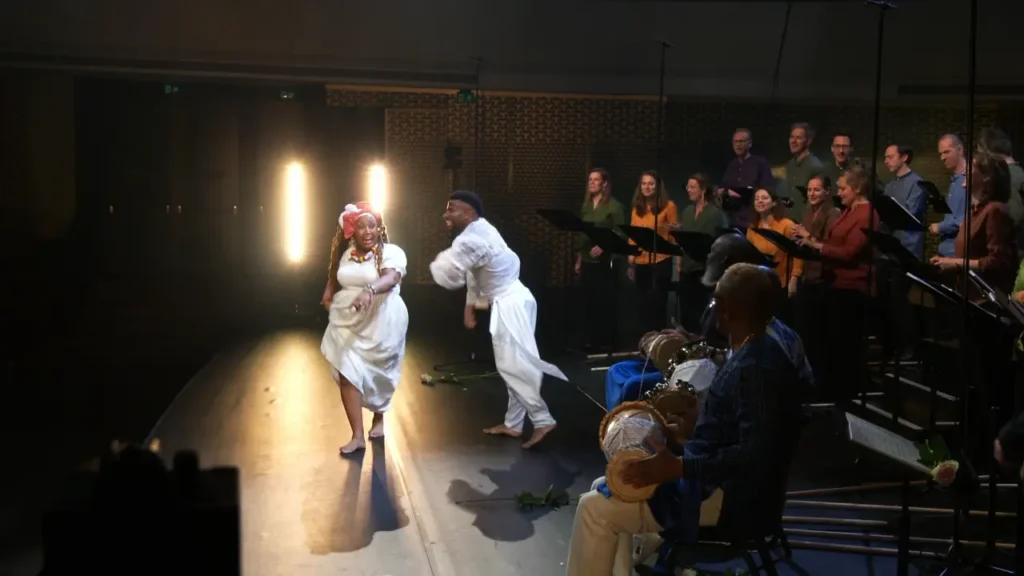
¡La otra Cuba! (2023)
Theatre and storytelling
Theatrical elements, such as spoken text and physical performance components, add an extra narrative layer to choral concerts. The use of a narrator can build a direct bridge between a historical source text and a contemporary audience.
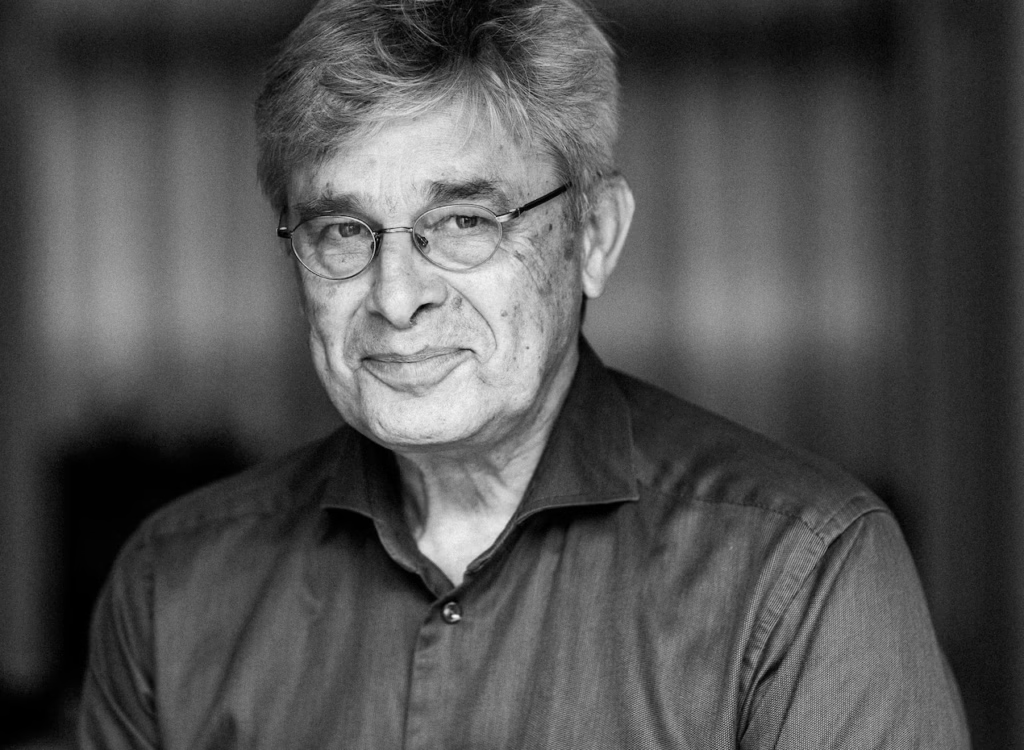
In De rechtvaardigen (2025), the author of the eponymous book, Jan Brokken, appeared as narrator. His contribution connected the musical dramaturgy with historical and social context, offering the audience a deeper interpretive framework.
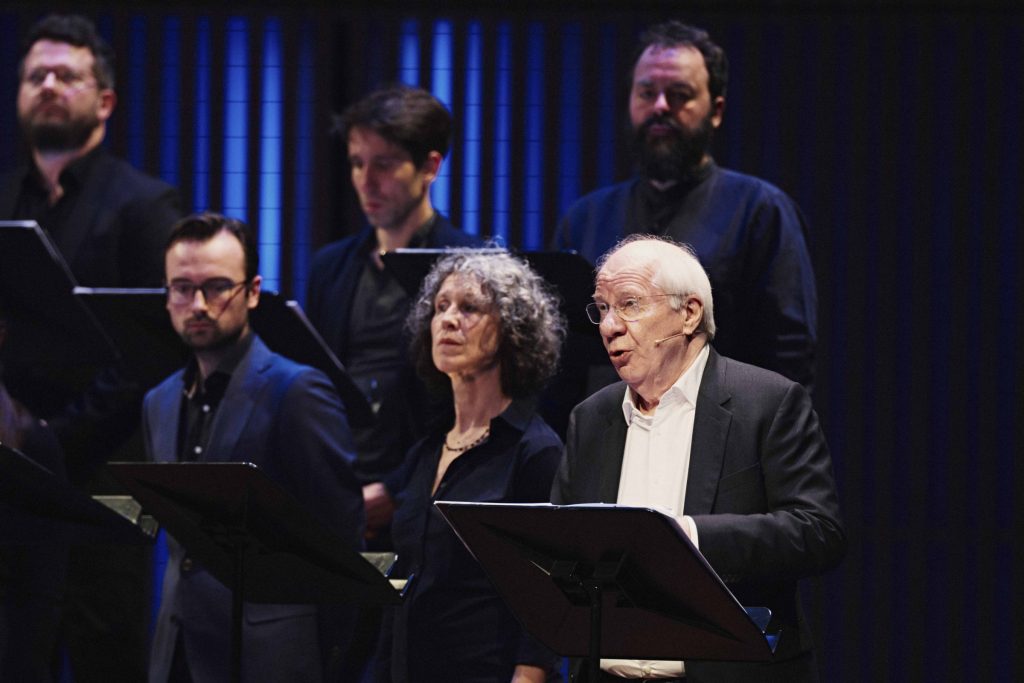
De rechtvaardigen (2025)
During Cantigas (2023 and 2026), storyteller Sahand Sahebdivani accompanied the programme with spoken passages that unlocked the thematic and historical background. This made both the texts and the music — and the world of medieval Córdoba — more immediately tangible.

Cantigas (2023)
Visual art and lighting design
Visual design — from lighting and scenography to projection — is also playing an increasingly significant role in contemporary choral concerts. When the visual layer follows the same arc of tension as the music, it amplifies the emotional charge of a performance.
In La Femme Lumineuse (2024), light was not deployed merely functionally but shaped dramaturgically. The lighting design by Floriaan Ganzevoort added colour, contrast, and symbolism to the musical structure, functioning as a visual partner to the score.
In concerts such as Zapp Mattheus, theatrical and visual elements were likewise integrated — through spatial scenography and contributions from student actors, among other things. The concert thereby becomes a staged listening experience.

Zapp Mattheus (2023)
Multidisciplinary ≠ decoration
The use of dance, theatre, and visual art is not an embellishment added for effect, but a considered artistic choice. These disciplines function as interpretive tools that clarify — and perhaps even deepen — the essence of the music. They influence how a work is perceived and understood: aurally, visually, and emotionally.
By approaching song, movement, and light in conjunction with one another, space is created for new perspectives on the repertoire without relinquishing the autonomy of the music. For Cappella Amsterdam, multidisciplinarity is not an end in itself, but a way of approaching repertoire from multiple angles.
By connecting different art forms organically with vocal music, choral concerts emerge that can be experienced and read on multiple sensory levels. This can lead to a more engaged listening experience, the reaching of new audiences, and the placing of our repertoire in relation to the present. But it always leads to fascinating, inspiring collaborations and the co-creation of an extraordinary concert in which the whole is experienced as something entirely different from the sum of its parts.