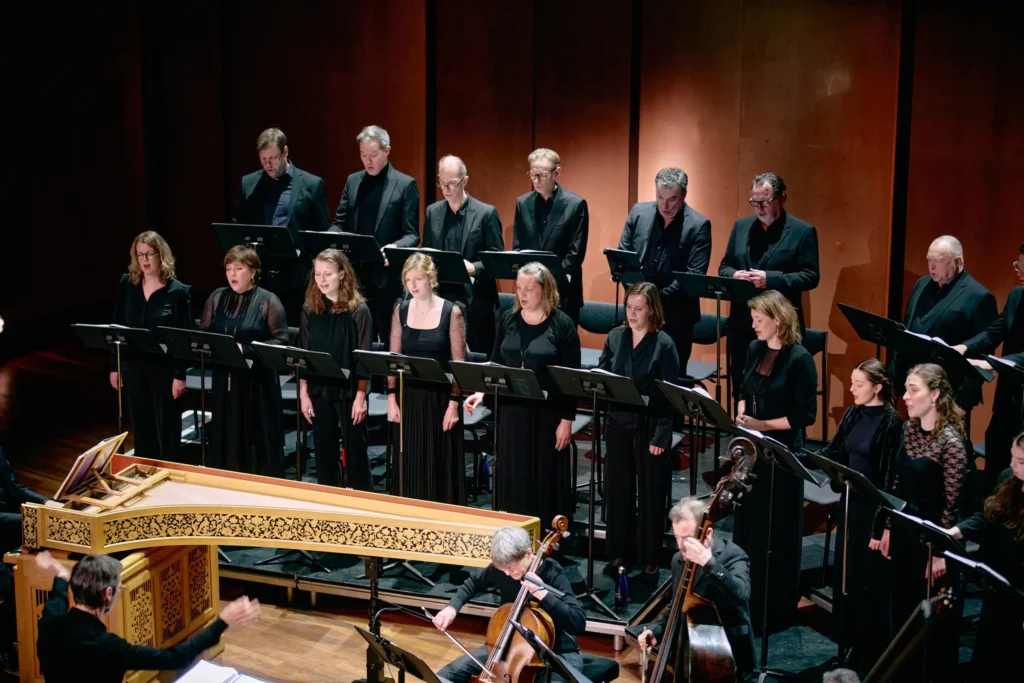
Under the direction of chief conductor Daniel Reuss, Cappella Amsterdam and the North Netherlands Orchestra present a program dedicated to the late works of Igor Stravinsky, one of the most influential composers of the 20th century. They are joined by an impressive group of soloists: Berit Norbakken (soprano), Marianne Beate Kielland (mezzo-soprano), Thomas Walker (tenor), Guy Cutting (tenor), Tobias Berndt (baritone), and Stephan MacLeod (bass-baritone).
Stravinsky, best known for his groundbreaking works such as Le Sacre du Printemps and Petrushka, only began experimenting with dodecaphony (twelve-tone technique) later in his career. Around the 1950s, he became increasingly influenced by the Second Viennese School, particularly Arnold Schoenberg and Anton Webern, the pioneers of dodecaphony or twelve-tone technique. Although Stravinsky was initially reluctant about this technique, he eventually adopted it in his own compositions, without losing his distinctive style and unique musical voice.
This program offers a glimpse into Stravinsky’s late style, where, even after embracing serial techniques, he maintained a close connection with sacred and commemorative rituals. Daniel Reuss has chosen a focus on “in memoriam” compositions that Stravinsky wrote in remembrance of literary and political figures, as well as works closely tied to Stravinsky’s own death.
Stravinsky was commemorated in New York and buried in Venice. At the ceremonies, Requiem Canticles (1966), Pater Noster (1926), and Bogoroditse Devo (also known as Ave Maria, 1934) were performed—sacred choral works that highlight Stravinsky’s connection to the Russian Orthodox faith.
In addition to Requiem Canticles, the program includes other serial compositions, such as Threni (1958) and Anthem: The Dove Descending Breaks the Air (1962). Threni marks the start of Stravinsky’s serial period, where he applied the strict structures of dodecaphony. Introitus: T.S. Eliot in Memoriam (1965) and Elegy for J.F.K. (1964) are Stravinsky’s tributes to modern figures who tragically passed away. In these works, he demonstrates his ability to capture the cadence of poetry and spoken language in a musical form.