
programme
Aftab Darvishi (*1987) Hamzaad (My Fellow) (world premiere)
Gerard Beljon (*1952) Planctus Cygni; part III
And traditional works from Lebanon, Syria, Egypt, Bosnia-Herzegovina, Morocco and Tunisia with Amira Medunjanin, Rima Khcheich, Anass Habib and Ahmed el Maai, among others:
¡Ay, de mi al-Ándalus! (Ibn Jafaya, 1058 – 1139, arr. Hugo Bouma)
Estoy hecha para la gloria (Wallada bint al-Mustakfi, 994 – 1091, edit. Hugo Bouma/Leonard Evers)
Sille Türküsü (Çoban Armağanı, 1933, comp. Ahmed Adnan Saygun)
Bebek (Çoban Armağanı, 1933, comp. Ahmed Adnan Saygun)
U Stambolu na Bosforu (trad., arr. Marijn van Prooijen)
Ajde Jano (trad., arr. Leonard Evers)
Asker Oldum Piyade (Dağlardan Ovalardan, 1939, comp. Ahmed Adnan Saygun)
Konyalım (Dağlardan Ovalardan, 1939, comp. Ahmed Adnan Saygun)
Ağıt: Hem Okudum Hemi Yazdım (Dağlardan Ovalardan, 1939, comp. Ahmed Adnan Saygun)
Ya maryamou l-bikr (trad., arr. Maarten Ornstein)
Ahu dalli sar (Sayyed Darwish, arr. Maarten Ornstein)
Idem kući, a već zora (trad., arr. Peter Vigh)
Li habibi oursil salam (from nuba bacit al-hijaz al-kabir, arr. Hugo Bouma)
Muwashah Yaa udhayb al-marshaf / Muwashah adhkuru l-hibba (arr. Maarten Ornstein)
Çanakkale Türküsü (Bir Tutam Kekik, 1943, comp. Ahmed Adnan Saygun)
Bogata sam, imam svega (Marko Nešić, 1873-1938, arr. Marijn van Prooijen)
performers
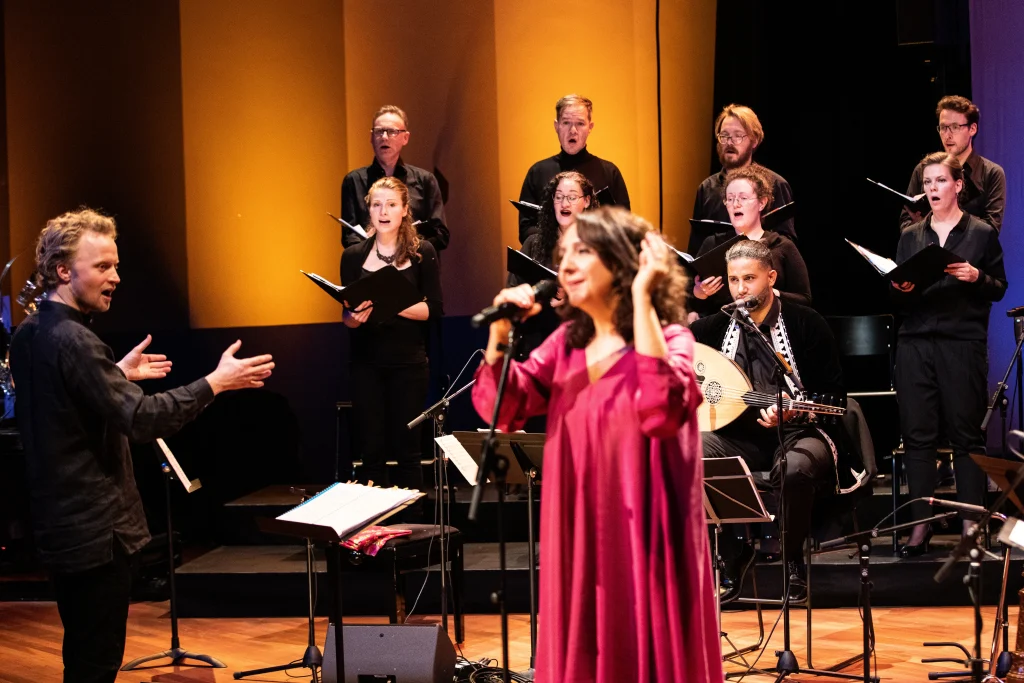
Cappella Amsterdam
Leonard Evers conductor
Raphaela Danksagmüller duduk, fujara
Sabra el Bahri-Khatri vocals
Ahmed el Maai ud, kanun and vocals
Anass Habib vocals
Misagh Joolaee kamancheh
Rima Khcheich vocals
Beate Loonstra harp
Amira Medunjanin vocals
Laura Rodrigues Lopes vocals
Claudio Spieler percussion
Ruven Ruppik percussion (The Hague & November Music)
background
Leonard Evers (artistic director of alBahr) believes that a distinction is often made between ‘Western’ music on one side and ‘Arab’ music on the other. However, for centuries, there has been a blending of influences around the coasts of the Mediterranean. In musical tradition, there has never been a strict division between East and West: the sea is a fluid center of exchange.
To demonstrate this, Evers developed the programme alBahr with (choir) music that clearly showcases this centuries-old exchange.
alBahr (“our sea” in Arabic)
For the concept of alBahr , Evers was inspired by composer Gerard Beljon’s work Planctus Cygni . Planctus Cygni paints a picture of a swan restlessly floating over the turbulent Mediterranean Sea, longing for a shore to call ‘home.’
Evers: “The underlying thematic line is ‘longing.’ Specifically, the longing for a stable place, a home. Many of the lyrics reflect this, including those by composers Gerard Beljon and Aftab Darvishi. Longing is a theme that defines almost all the music in this project, not only through the individual texts but also as a whole. Everyone longs for a home, and you can hear this longing in alBahr, through all the works, regardless of their musical genre.”
Arrangers Hugo Bouma, Maarten Ornstein, Marijn van Prooijen, and Peter Vigh are adapting traditional music from Bosnia and Herzegovina, Lebanon, and Morocco for this project.
With alBahr , we take you on a journey along the Mediterranean.
For this occasion, Iranian-Dutch composer Aftab Darvishi is writing a new work in Farsi for choir and instrumental soloists: HamZaad, Persian for ‘my companion.’ The work is inspired by a poem by the Persian poet هوشنگ ابتهاج (Hooshang Ebtehaj) about longing for a voice once heard among the stars. Darvishi is a sought-after composer who has previously collaborated with the Kronos Quartet, Hermesensemble, Oerknal, and De Ereprijs. Not so long ago, her opera Turan Dokht premiered at the Holland Festival.
design
Light artist Frouke ten Velden collaborates with choreographer Peter Leung, known for his work with the National Opera & Ballet, to visually take you on a journey along the coasts of the Mediterranean.
ud festival
The ud is an ancient twelve-string lute from the Middle East that made its way to Western Europe via the Mediterranean. The Ud Festival has been organized by the Amsterdam Andalusian Orchestra since 2016. The ud can be heard in jazz, world, early music and contemporary music. This edition is a journey from Baghdad to the Netherlands, traversing history and showcasing a wide variety of musical styles.
From shared roots in Oriental, Gregorian, and Western music, we unveil a new sound with this concert and as part of the Ud Festival, featuring renowned masters and young talents.
"When I play the ud, I feel how this instrument has risen above itself in various corners over the centuries along the shores of the Mediterranean."